1. Introduction: Why Lithium Battery Pack Performance Validation Matters
Lithium-ion batteries are widely used in electric vehicles, industrial equipment, and battery energy storage systems. As battery applications become more demanding, manufacturers and system integrators must ensure that every battery pack delivers consistent performance under defined operating conditions.
A battery pack may pass basic voltage checks and still have problems that only become apparent during actual operation. Insufficient charge acceptance, unexpected voltage drops, inconsistent discharge behavior, and abnormal temperature increases can affect battery reliability and service life.
This is why Lithium Battery Pack Performance Validation is an important part of battery manufacturing, quality assurance, maintenance, and system integration.
Performance validation involves applying controlled charging and discharging conditions, monitoring electrical parameters, and evaluating how a battery pack responds throughout different test stages. Rather than relying on a single measurement, engineers assess multiple performance indicators under repeatable conditions.
For EV battery manufacturers, validation helps verify pack performance before delivery. For energy storage integrators, it provides additional confidence when evaluating battery packs before system commissioning. For battery service providers, it supports technical diagnosis and post-repair verification.
A properly configured battery testing process also helps organizations establish consistent inspection procedures, improve production quality, and maintain more reliable test records.
This article explains the key parameters, testing methods, procedures, and equipment selection considerations involved in lithium battery pack performance validation.
2. Key Parameters in Lithium Battery Pack Performance Validation
A meaningful validation process should evaluate several electrical and operational parameters rather than focusing exclusively on nominal voltage or rated capacity.
2.1 Voltage Characteristics
Voltage is one of the most important indicators of battery operating conditions.
Engineers generally monitor pack voltage during charging, discharging, and rest periods. The measured values help identify whether the battery operates within its specified voltage range.
For battery packs containing multiple series-connected cells, individual cell voltage monitoring can provide additional information about voltage consistency.
Unexpected voltage differences between cells may indicate imbalance or other issues requiring further investigation.
2.2 Charging Current and Charge Acceptance
Charging performance is an important consideration for both EV batteries and energy storage systems.
A controlled charging test helps evaluate how a battery responds to different current settings and charging stages.
Engineers may examine:
- Charging current stability.
- Voltage response during charging.
- Transition from constant-current to constant-voltage charging.
- Charging time under specified test conditions.
- Temperature changes during charging.
These measurements help determine whether the battery pack responds consistently to its defined charging profile.
2.3 Discharge Performance
Discharge testing evaluates how a battery delivers electrical energy under a specified load.
Depending on the application, engineers may use constant-current (CC) or constant-power (CP) discharge modes.
Important parameters include discharge current, output voltage, discharge duration, delivered capacity, and energy.
A voltage drop that occurs earlier than expected may indicate insufficient performance or a potential battery issue. However, results should always be interpreted against the manufacturer’s specifications and the defined test conditions.
2.4 Temperature Behavior
Temperature monitoring is particularly important when evaluating lithium battery packs.
Abnormal temperature increases during charging or discharging may indicate excessive resistance, poor thermal management, or other potential problems.
For applications requiring additional monitoring, optional temperature measurement can help engineers identify abnormal operating conditions during testing.
3. Controlled Charging Verification: Evaluating Battery Response
Charging verification examines how a battery pack responds to a defined charging strategy.
For many lithium-ion battery applications, constant-current and constant-voltage (CC-CV) charging is commonly used.
During the constant-current stage, the charging equipment maintains a specified current while battery voltage gradually increases.
When the battery reaches the configured voltage limit, the process transitions to the constant-voltage stage. The charging voltage is maintained while current gradually decreases according to the battery’s characteristics and charging requirements.
During validation, engineers should record the charging voltage and current throughout the process.
Several factors should be considered:
Charging current consistency: The equipment should maintain the configured current within its specified operating accuracy.
Voltage control: The charging voltage must remain within the battery manufacturer’s permitted limits.
Charging profile: The transition between charging stages should follow the defined test procedure.
Temperature monitoring: Temperature should be observed to identify abnormal heating.
Test repeatability: Repeating the same charging procedure under comparable conditions helps engineers evaluate consistency.
It is important to distinguish performance validation from charging speed optimization. A shorter charging time does not automatically indicate better battery performance. The test must follow the battery manufacturer’s charging specifications and applicable application requirements.
4. Discharge Performance Verification: CC and CP Testing
Discharge verification provides valuable information about the battery pack’s ability to deliver power under controlled operating conditions.
Two commonly used discharge modes are constant-current and constant-power testing.
4.1 Constant-Current Discharge
In constant-current discharge mode, the equipment maintains a predefined discharge current throughout the test.
This method is useful when engineers need to evaluate battery behavior under a stable current demand.
During the process, the testing system records voltage changes and discharge duration. The results can be used to calculate delivered capacity and evaluate voltage stability.
Constant-current testing is suitable for evaluating battery performance under defined current loads.
4.2 Constant-Power Discharge
In constant-power mode, the testing equipment maintains a specified power level while discharge current changes according to the battery’s output voltage.
As voltage decreases, the current may increase to maintain the configured power, provided that the equipment and battery operating limits allow it.
This method is particularly relevant when evaluating battery packs used in applications with relatively consistent power demands.
For EV and energy storage applications, constant-power testing can help engineers understand how a battery responds to a defined power requirement.
4.3 Setting Appropriate Discharge Limits
Discharge cut-off voltage is a critical parameter.
Continuing discharge beyond the permitted lower voltage limit may damage battery cells or create safety risks.
Before testing, engineers should confirm:
- The battery chemistry and nominal voltage.
- The manufacturer’s upper and lower voltage limits.
- The maximum permitted discharge current and power.
- The required test duration or termination conditions.
- Temperature limits and protection settings.
The equipment should be configured according to the battery manufacturer’s specifications rather than using a universal discharge threshold.
5. Battery Pack Cycle Validation and Test Repeatability
A single charge or discharge test provides only a limited view of battery behavior.
For applications requiring more comprehensive evaluation, engineers may perform multiple charge-discharge cycles using predefined test profiles.
A typical cycle validation procedure includes:
- Confirming the battery pack’s identification and initial condition.
- Setting the charging voltage and current limits.
- Performing controlled charging according to the selected profile.
- Allowing the required rest period, if specified.
- Applying a defined discharge current or power.
- Recording voltage, current, capacity, and other available measurements.
- Repeating the procedure according to the test plan.
- Comparing results across different cycles.
Cycle testing can help identify changes in delivered capacity, charging behavior, discharge characteristics, and temperature response.
However, short-term cycle validation should not be confused with a complete battery lifetime test. Long-term degradation studies require much longer test periods and additional environmental and operational controls.
Why Test Repeatability Matters
For battery manufacturers and professional testing laboratories, repeatability is essential.
If charging and discharging parameters change between tests, comparing results becomes difficult.
Programmable test profiles help standardize operating conditions and reduce unnecessary manual adjustments.
Engineers should also maintain consistent procedures for battery temperature, initial state of charge, rest periods, test termination, and measurement recording.
This approach makes test results more useful for quality control and engineering analysis.
6. Applications Across EV and Energy Storage Industries
Lithium battery pack performance validation serves different purposes across the battery supply chain.
6.1 Electric Vehicle Battery Manufacturing
EV battery manufacturers need to evaluate battery packs before they enter vehicle integration or delivery.
Charging and discharging tests help verify electrical behavior under defined conditions and provide records for quality inspection.
For production environments, programmable test profiles can help standardize procedures across different battery pack models.
6.2 Energy Storage System Integration
Battery packs used in commercial and industrial energy storage systems must meet application-specific electrical requirements.
Before system commissioning, integrators may perform charging and discharging verification to evaluate pack behavior and identify potential inconsistencies.
This is especially important when multiple battery packs are integrated into a larger storage system.
6.3 Battery Repair and Service Centers
After battery pack repair or component replacement, technicians need to verify that the battery operates according to the required specifications.
Controlled charging and discharging procedures provide a practical way to evaluate electrical performance before the pack is returned to service.
6.4 Battery Research and Testing Laboratories
Testing laboratories may require configurable charging and discharging conditions to evaluate different battery chemistries, pack configurations, and operating profiles.
A flexible testing platform can support different test requirements without relying on separate equipment for every operating mode.
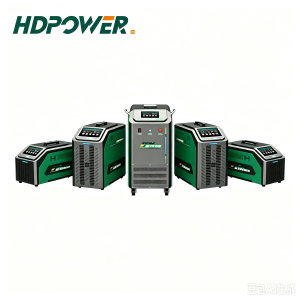
HDPOWER provides a range of Lithium Battery Testing Equipment for evaluating lithium battery cells, modules, and battery packs in EV, energy storage, and industrial applications.
7. How to Select Equipment for Lithium Battery Pack Performance Validation
Choosing suitable equipment is an important decision for battery manufacturers, laboratories, and system integrators.
The equipment should match the electrical specifications of the battery packs and the requirements of the intended testing procedures.
7.1 Voltage and Current Range
The first consideration is the operating voltage range.
Battery testing equipment should cover the minimum and maximum voltage requirements of the target battery packs.
Current and power capacity are equally important. Undersized equipment may not support the required test conditions, while unnecessarily oversized equipment may increase investment costs.
For organizations testing different battery pack models, selecting an appropriate operating range can improve equipment utilization.
7.2 Multiple Operating Modes
A practical testing platform should support the operating modes required by the test plan.
Constant-current and constant-voltage charging, together with constant-current and constant-power discharging, provide flexibility for different validation procedures.
The ability to configure charging and discharging parameters independently is particularly useful when working with different battery specifications.
7.3 Programmable Test Profiles
Manual parameter adjustment can become inefficient when engineers need to perform repeated tests.
Programmable profiles help establish consistent procedures and reduce the possibility of configuration errors.
For battery manufacturers and professional service centers, this functionality can improve workflow efficiency and make repeated testing easier to manage.
7.4 Protection and Monitoring Functions
Lithium battery testing requires appropriate protection measures.
When evaluating equipment, engineers should consider available voltage, current, temperature, and other relevant protection functions.
Optional cell voltage and temperature monitoring can provide additional visibility into battery pack conditions.
Where supported, automatic alarm and shutdown functions can help respond to configured abnormal conditions.
The protection configuration must always be matched to the battery specifications and test environment.
7.5 Data Recording and Export
Reliable test records are valuable for quality assurance, engineering analysis, and customer reporting.
Look for equipment that can record test parameters and export data for further review.
A touchscreen interface and USB data export can simplify test operation and make it easier to transfer records to a computer for analysis.
For organizations managing multiple battery models, structured test records also support traceability and internal quality procedures.
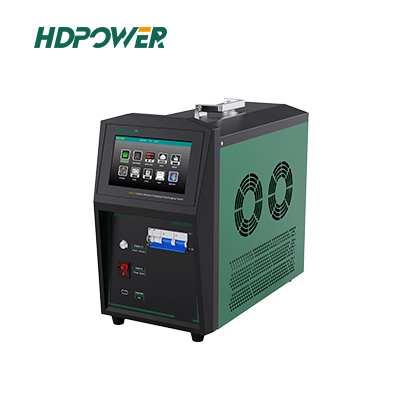
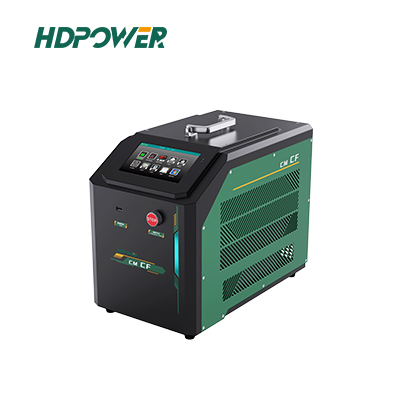
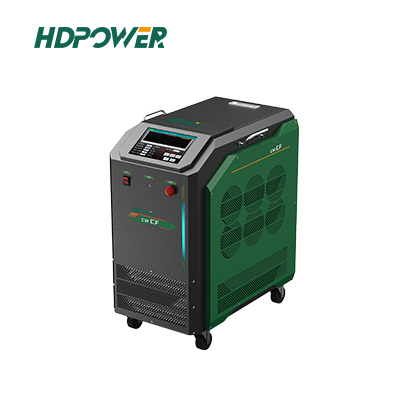
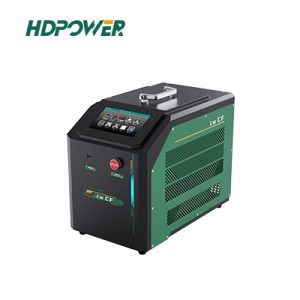
For applications that require controlled charging, discharging, and cycle testing, the CM-CF Lithium Battery Charge Discharge Tester provides an integrated solution for evaluating lithium battery pack performance.
8. HDPOWER CM-CF Lithium Battery Testing Solution
For organizations requiring integrated charging and discharging functions, HDPOWER provides the CM-CF series of lithium battery charging and discharging equipment.
Designed for lithium battery pack testing, maintenance, and related applications, the CM-CF series combines charging and discharging functions in one platform.
Its available configurations cover different voltage requirements, helping customers select equipment according to their battery pack specifications.
Key capabilities include:
- Wide Voltage Compatibility: Available configurations cover different operating voltage requirements for lithium battery applications.
- Multiple Battery Chemistries: Supports applicable LiFePO4 and NCM/NMC battery applications.
- CC/CV Charging: Supports constant-current and constant-voltage charging modes.
- CC/CP Discharging: Provides constant-current and constant-power discharge modes for different testing requirements.
- Programmable Test Procedures: Supports configurable charging, discharging, and cycle-related test profiles.
- Battery Activation and SOC Matching: Supports configured procedures for battery conditioning and SOC-related matching applications.
- Optional Cell Monitoring: Cell voltage and temperature monitoring can be selected for applications requiring additional measurement visibility.
- Alarm and Protection Functions: Available protection functions help manage abnormal operating conditions.
- Touchscreen Operation: A 7-inch touchscreen provides a convenient interface for parameter configuration and test operation.
- USB Data Export: Test records can be exported for further analysis and documentation.
The CM-CF series can be considered by EV battery service providers, battery pack manufacturers, energy storage integrators, and other organizations that require configurable lithium battery charging and discharging capabilities.
For customers with different voltage, current, and power requirements, selecting the appropriate configuration is essential.
HDPOWER can help evaluate application requirements and recommend a suitable equipment configuration.
9. Conclusion: Building a More Reliable Battery Validation Process
Lithium battery pack performance validation is an important part of battery quality assurance, system integration, and maintenance.
By combining controlled charging, constant-current and constant-power discharging, cycle testing, and parameter monitoring, engineers can obtain a more comprehensive understanding of battery pack behavior.
The reliability of the validation process depends not only on the testing equipment but also on clearly defined procedures, appropriate operating limits, consistent test conditions, and accurate data recording.
For battery manufacturers, energy storage integrators, EV service providers, and testing laboratories, selecting flexible equipment that matches actual application requirements can improve testing efficiency and support more consistent quality management.
HDPOWER provides configurable CM-CF lithium battery charging and discharging solutions for different battery pack applications.
Looking for a suitable solution for your lithium battery pack validation requirements? Contact HDPOWER to discuss your battery specifications, testing parameters, and equipment configuration.