-
Introduction to Battery Cell Voltage Testing
Lithium battery packs are widely used in electric vehicles, energy storage systems, industrial equipment, electric forklifts, and other applications requiring reliable power. As these battery systems operate over time, individual cells may gradually develop differences in voltage, capacity, and charging characteristics. Even when cells originally have similar specifications, operating conditions and aging can cause their electrical performance to become inconsistent.
Battery cell voltage testing is an important procedure for identifying these differences and evaluating the condition of individual cells within a battery module or pack. By measuring cell voltage accurately, maintenance technicians can identify abnormal voltage behavior, locate potentially problematic cells, and determine whether further testing or maintenance is required.
For battery repair centers, manufacturers, and energy storage operators, reliable voltage measurement is not simply a routine inspection task. It is an essential part of battery performance evaluation, preventive maintenance, and troubleshooting.
This article explains how battery cell voltage testing works, what causes voltage deviations, which testing methods are commonly used, and how professional testing equipment can improve the efficiency and accuracy of battery maintenance.
-
Why Is Battery Cell Voltage Testing Important?
A lithium battery pack usually consists of multiple cells connected in series, parallel, or a combination of both configurations. In a series-connected battery string, the same current passes through each cell, but individual cells may respond differently because of variations in capacity, internal resistance, temperature, and aging.
These differences can gradually affect the overall performance of the battery system.
2.1 Identifying Abnormal Cells
When one cell exhibits a voltage significantly different from the others under comparable conditions, it may indicate an abnormal operating condition.
For example, a cell that reaches its upper voltage limit earlier than neighboring cells may have reduced charge acceptance or different capacity characteristics. Similarly, a cell that experiences a faster voltage drop during discharge may require further investigation.
Voltage testing helps technicians identify these differences before they develop into more serious performance problems.
2.2 Improving Battery Pack Consistency
Battery pack performance is influenced by the condition of its individual cells. In a series-connected configuration, the weakest cell can limit the usable performance of the entire battery string.
Accurate voltage measurements help maintenance personnel evaluate cell-to-cell consistency and determine whether balancing maintenance is appropriate.
2.3 Supporting Preventive Maintenance
Regular voltage inspections provide useful information about changes in battery behavior over time. By comparing historical test records, technicians can identify cells that repeatedly exhibit abnormal voltage patterns.
This makes it easier to develop maintenance schedules, investigate recurring problems, and reduce unexpected battery downtime.
2.4 Improving Battery Safety Management
Overvoltage and undervoltage conditions can damage lithium battery cells and increase operational risks. Reliable voltage monitoring helps identify cells approaching their specified operating limits.
However, voltage measurements should always be evaluated together with temperature, current, battery management system information, and manufacturer-defined safety limits.
-
Common Causes of Battery Cell Voltage Differences
Understanding why voltage differences occur is essential for selecting the correct testing and maintenance procedure.
Manufacturing variations
Even cells produced within the same manufacturing batch may have small differences in capacity, internal resistance, and electrochemical characteristics. These variations can influence their voltage response during charging and discharging.
Uneven temperature distribution
Battery temperature affects electrochemical reactions and internal resistance. Cells operating at different temperatures may exhibit different voltage characteristics, particularly under load.
Different aging rates
Battery cells do not necessarily degrade at the same rate. Differences in usage history, charge-discharge cycles, and operating environments can cause some cells to lose capacity faster than others.
Inconsistent charging and discharging conditions
Uneven current distribution, incomplete charging, and repeated operation under different load conditions can contribute to cell voltage differences.
Internal resistance changes
As cells age, their internal resistance may increase. A cell with higher internal resistance can experience a larger voltage drop during discharge and a larger voltage rise during charging.
These causes are not mutually exclusive. A voltage difference is an observation, not a definitive diagnosis. Technicians should combine voltage measurements with other relevant test results before deciding on maintenance actions.
-
How to Perform Battery Cell Voltage Testing
A systematic testing procedure helps improve measurement reliability and reduces the possibility of incorrect diagnosis.
Step 1: Confirm Battery Specifications
Before testing, identify the battery chemistry, nominal voltage, cell configuration, and manufacturer-defined operating limits.
Different lithium chemistries have different voltage characteristics. For example, lithium iron phosphate (LFP) and nickel manganese cobalt (NMC) cells have different nominal and maximum charging voltages.
Using incorrect voltage limits may result in misleading test conclusions or unsafe operating conditions.
Step 2: Inspect the Battery and Connections
Check the battery module, connectors, sampling cables, and measurement terminals before connecting the testing equipment.
Loose connections, oxidation, damaged cables, or incorrect wiring can affect measurement accuracy. Ensure that the equipment is compatible with the battery configuration and that all connections follow the manufacturer’s instructions.
Step 3: Measure Individual Cell Voltages
Measure the voltage of each accessible cell or cell group using a suitable measuring instrument.
For a battery module containing multiple series-connected cells, record individual voltage readings rather than relying exclusively on total pack voltage.
A normal-looking pack voltage does not necessarily mean that every individual cell is operating normally.
Step 4: Record the Testing Conditions
Voltage readings are affected by operating conditions. Therefore, technicians should record:
- Battery temperature
- Charging or discharging status
- Resting time before measurement
- State of charge, where available
- Individual cell voltage
- Measurement equipment and test settings
For meaningful comparisons, cells should be evaluated under comparable conditions. Measurements taken during active charging or discharging should not be directly compared with measurements taken after an extended resting period.
Step 5: Compare Voltage Differences
After collecting the readings, identify the highest and lowest cell voltages.
The voltage difference can be calculated as:
Voltage Difference = Highest Cell Voltage − Lowest Cell Voltage
For example, if the highest cell voltage is 3.42 V and the lowest is 3.37 V, the measured difference is 0.05 V, or 50 mV.
This value provides an initial indication of voltage consistency. However, it should not be treated as a universal pass-or-fail threshold. Acceptable differences depend on battery chemistry, state of charge, temperature, load conditions, and manufacturer specifications.
Step 6: Determine Whether Further Maintenance Is Necessary
If a cell repeatedly shows unusual voltage behavior, additional tests may be required.
Technicians can evaluate internal resistance, capacity, temperature behavior, and charging or discharging response to determine whether the issue is caused by temporary operating conditions, cell degradation, or a more serious defect.
Balancing should only be performed when the battery condition and test results indicate that it is appropriate.
-
Key Parameters for Evaluating Battery Cell Performance
Voltage is one of the most useful parameters in battery inspection, but it should not be considered independently.
Cell Voltage
Individual cell voltage indicates the electrical potential of a cell at a particular moment. It helps technicians identify abnormal readings and compare cells within the same module.
Voltage Deviation
Voltage deviation describes the difference between individual cell readings. Monitoring this parameter helps evaluate consistency and identify cells that may require further investigation.
Internal Resistance
Internal resistance affects voltage response under charging and discharging conditions. A cell with unusually high resistance may experience greater voltage changes under load.
Temperature
Temperature influences battery performance, charging behavior, and voltage response. Temperature measurements help technicians identify thermal differences that may contribute to inconsistent cell behavior.
Capacity
Voltage alone cannot accurately determine the remaining capacity or overall health of a lithium battery cell. Capacity testing under controlled charging and discharging conditions provides additional information about actual energy storage performance.
Combining these parameters provides a more complete understanding of battery condition than relying on a single voltage measurement.
-
Common Challenges in Manual Battery Voltage Testing
Traditional handheld multimeters are useful for basic voltage inspections, but manual testing becomes less efficient when dealing with battery modules containing many cells.
Time-consuming measurement
Technicians may need to measure each cell individually, record the results, and compare the readings manually. This process becomes increasingly time-consuming as the number of cells increases.
Inconsistent measurement records
Manual data recording can introduce transcription errors and make it difficult to compare results from different maintenance sessions.
Limited simultaneous monitoring
A handheld instrument generally measures one point at a time. It may not provide a convenient overview of voltage changes across multiple cells during a maintenance process.
Limited maintenance functions
Basic voltage measurement instruments cannot independently perform controlled charging, discharging, and balancing operations on individual cells.
For professional battery maintenance operations, these limitations create a need for more integrated testing equipment.
-
How Professional Equipment Improves Battery Cell Voltage Testing
Professional battery testing equipment can combine voltage measurement, channel management, data recording, and maintenance functions in one system.
For lithium battery module maintenance, a suitable multi-channel testing system can monitor multiple cells and support controlled charging, discharging, and balancing operations.
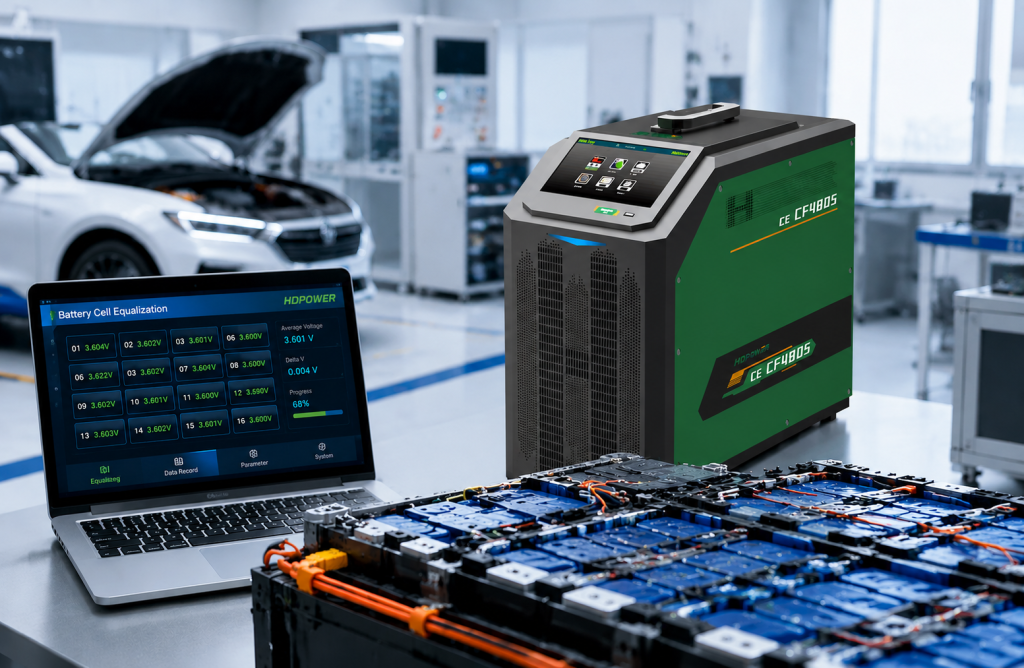
The HDPOWER CE-CF series is designed for voltage difference maintenance and performance evaluation of lithium battery cells and modules. For applications requiring multi-cell voltage measurement and maintenance, the CE-CF24 lithium battery equalizing tester provides 24-channel configuration, independent channel control, and high-precision voltage measurement to support lithium battery module maintenance.

Depending on the model, its key capabilities include:
High-Precision Voltage Measurement
Applicable CE-CF models provide voltage measurement and control accuracy of up to ±1 mV, supporting more precise evaluation of individual cell voltage differences.
Independent Channel Operation
Independent channel architecture allows technicians to manage different cells or cell groups according to their individual conditions. This is particularly useful when multiple cells require different maintenance settings.
Multiple Maintenance Modes
The equipment supports charging, discharging, and equalization maintenance modes. Technicians can select an appropriate operating procedure according to the battery condition and maintenance objective.
Real-Time Data Monitoring
The 7-inch touchscreen provides access to cell voltage, current, and operating status information, helping operators monitor the maintenance process.
Modular Configuration
Different CE-CF models support different cell configurations. Depending on the selected model, the system can accommodate battery modules ranging from 12 to 72 series cells.
These capabilities make professional equipment useful for battery repair centers, EV maintenance facilities, energy storage service providers, and battery manufacturers.
For detailed specifications and model selection, explore HDPOWER’s lithium battery equalizing tester.
-
Applications of Battery Cell Voltage Testing
Electric Vehicle Battery Maintenance
EV battery repair centers use cell voltage testing to investigate reduced driving range, inconsistent module performance, and battery management system warnings.
By identifying abnormal cells and comparing their voltage behavior, technicians can determine whether further module-level testing or maintenance is required.
Energy Storage System Maintenance
Battery energy storage systems contain numerous interconnected modules that operate under changing charge and discharge conditions.
Regular cell voltage inspections help maintenance teams monitor battery consistency, investigate abnormal voltage behavior, and support preventive maintenance programs.
Battery Manufacturing and Quality Control
Battery manufacturers use voltage measurements during cell screening, module assembly, and quality inspection.
Consistent testing procedures help identify abnormal cells before they are integrated into larger battery systems.
Battery Repair and Recycling
During battery repair, grading, and second-life evaluation, voltage testing provides useful information for identifying differences between cells and modules.
Combined with capacity and internal resistance testing, it supports more informed decisions about reuse, maintenance, and replacement.
-
How to Choose Suitable Battery Cell Testing Equipment
Selecting the right testing equipment depends on the battery configuration, maintenance requirements, and testing environment.
Consider the following factors:
Voltage Measurement Accuracy: Choose equipment with measurement accuracy suitable for identifying the voltage differences relevant to your application.
Channel Configuration: Consider the number of cells or modules that need to be tested simultaneously. A modular system can provide greater flexibility when working with different battery configurations. For applications requiring high-current multi-channel testing, the CE-CF multi-channel battery testing equipment supports 4-channel and 8-channel configurations, with independent channel operation and charging, discharging, and equalization functions.

Maintenance Functions: Determine whether your operation requires voltage measurement only or also needs controlled charging, discharging, and balancing.
Battery Compatibility: Confirm that the equipment supports the battery chemistry and voltage range used in your application.
Data Management: Data storage, communication interfaces, and report generation can improve maintenance traceability and simplify performance comparisons.
Protection Functions: Overvoltage, undervoltage, overcurrent, overtemperature, reverse connection, and other protections are important considerations when selecting professional battery maintenance equipment.
The most suitable solution is one that matches the actual battery configuration and maintenance workflow rather than simply offering the largest number of functions.
-
Conclusion
Battery cell voltage testing is an important procedure for evaluating lithium battery consistency, identifying abnormal cells, and supporting reliable battery maintenance.
Accurate voltage measurements help technicians understand how individual cells behave within a battery module. When combined with internal resistance, temperature, and capacity testing, voltage analysis provides a more comprehensive basis for battery diagnosis.
For professional maintenance operations, multi-channel equipment can simplify testing procedures and support controlled cell maintenance.
HDPOWER provides CE-CF series lithium battery testing and maintenance equipment designed for battery module voltage difference maintenance, including high-precision measurement, independent channel operation, and multiple maintenance modes.
Whether used in EV battery repair, energy storage maintenance, or battery manufacturing, a systematic approach to cell voltage testing helps improve maintenance efficiency and supports more reliable battery performance.
If you are looking for professional equipment for lithium battery cell testing and maintenance, contact HDPOWER to discuss a suitable solution for your application.