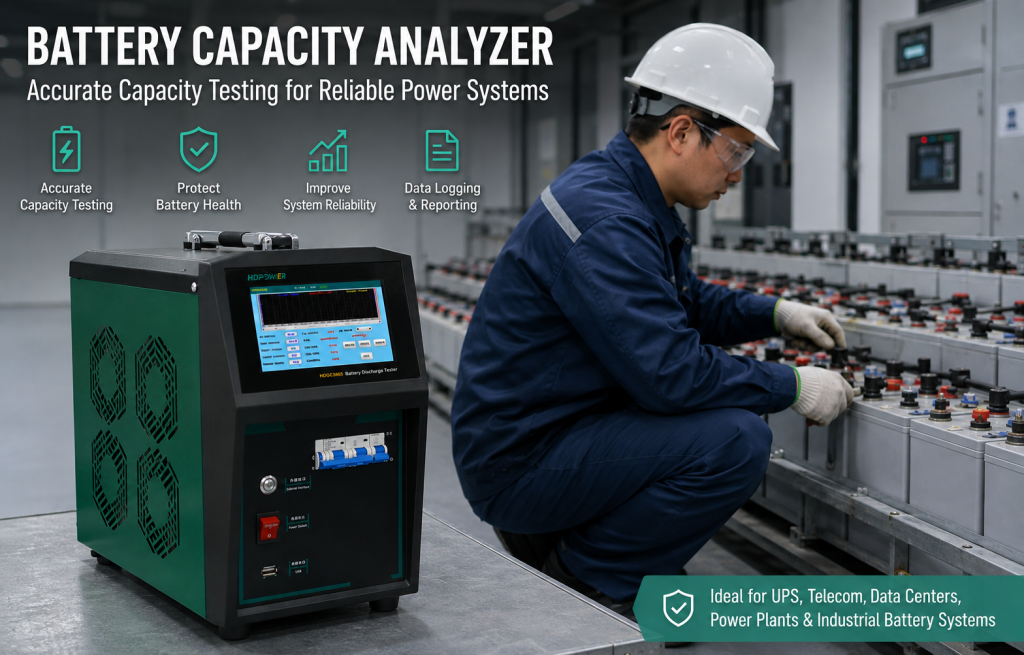
Introduction
Battery capacity is one of the most important indicators of whether a backup battery system can deliver power when it is actually needed. A battery may show a normal voltage during routine inspection while its available capacity has already declined because of aging, sulfation, high internal resistance, temperature, or prolonged standby operation.
For this reason, battery maintenance teams need more than a simple voltage measurement. Battery Capacity Verification Equipment provides a practical way to evaluate whether a battery or battery bank can still deliver the required amount of energy under defined testing conditions.
This is particularly important for UPS systems, telecommunications facilities, substations, data centers, industrial control systems, and other applications where battery failure can affect system availability.
What Is Battery Capacity Verification?
Battery capacity verification is the process of determining whether a battery can provide its expected capacity under specified operating conditions.
For a battery rated in ampere-hours (Ah), capacity is generally associated with the amount of current the battery can deliver over a defined period before reaching a specified end-of-discharge voltage. In practical maintenance, however, the purpose is not simply to obtain a theoretical Ah value. Engineers need to determine whether the installed battery system still provides sufficient backup capability.
A complete Battery Capacity Verification process may therefore consider:
- Battery voltage
- Discharge current
- Discharge duration
- End-of-discharge voltage
- Individual cell voltage
- Internal resistance
- Battery temperature
- Historical test results
- Rated capacity versus measured capacity
Different testing technologies can be used depending on the battery chemistry, system configuration, and required testing accuracy.
For industrial applications, selecting appropriate battery testing equipment is therefore an important part of battery maintenance planning.
Why Battery Capacity Verification Matters
Standby batteries can deteriorate without obvious external symptoms. A battery bank may remain connected to a charger and maintain an acceptable float voltage while its actual energy-delivery capability gradually decreases.
Several factors can contribute to capacity loss.
Battery aging
Lead-acid batteries gradually lose capacity as they age. Plate corrosion, sulfation, electrolyte deterioration, and other mechanisms can reduce the amount of energy available during discharge.
Lithium batteries also experience capacity degradation through charge-discharge cycling, calendar aging, temperature exposure, and operating conditions.
High internal resistance
An increase in internal resistance can cause a larger voltage drop when the battery is subjected to load. This may reduce the usable capacity of the battery even when its open-circuit voltage appears normal.
For this reason, internal resistance measurements are often useful as part of a broader battery condition assessment.
Uneven cell performance
A battery bank is only as reliable as its weakest components. One degraded cell can cause abnormal voltage behavior during discharge and potentially reduce the usable performance of the entire battery string.
Individual cell monitoring is therefore particularly valuable when conducting Battery Bank Capacity Verification.
Long standby periods
Backup batteries may spend most of their operating life in standby mode. Because they are rarely subjected to deep discharge during normal operation, deterioration may remain unnoticed until an actual power interruption occurs.
Periodic capacity verification helps maintenance teams identify degradation before the battery is required to perform an emergency backup function.
Common Methods for Battery Capacity Verification
There is no single testing method suitable for every battery application. Industrial maintenance programs commonly combine several types of measurements.
- Voltage and internal resistance testing
Voltage and internal resistance measurements are useful for quickly screening individual cells or batteries.
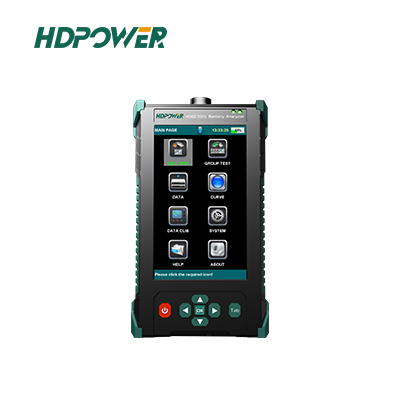
A handheld battery ir tester can measure battery voltage and internal resistance without requiring a long discharge test. This makes it useful for routine inspections and identifying abnormal cells.
However, internal resistance testing should not automatically be treated as a direct replacement for a controlled capacity test. A resistance measurement provides information about battery condition, while a capacity test evaluates actual energy delivery under defined discharge conditions.
- Controlled discharge testing
Controlled discharge is a direct approach to verifying battery capacity.
During the test, the battery or battery bank is discharged using a defined current or power level until a specified end voltage is reached. The equipment records the relevant electrical parameters throughout the test.
This method can provide more direct information about the battery’s actual discharge capability.
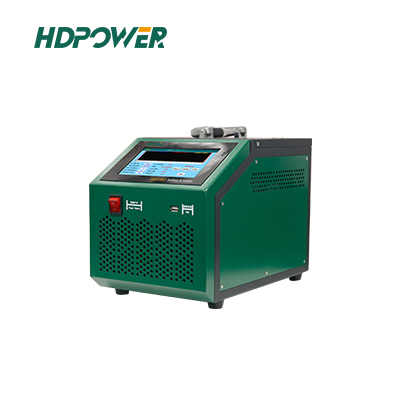
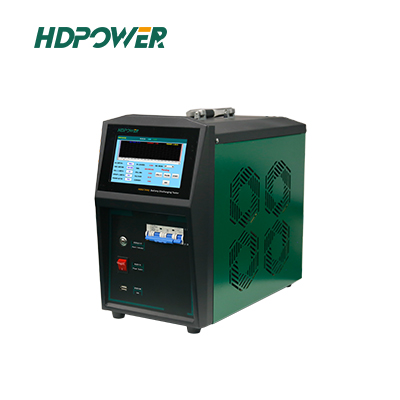
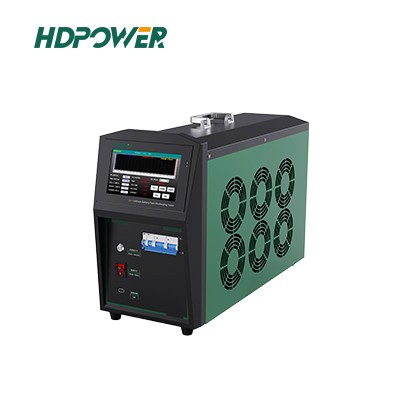
For large backup systems, battery discharge tester may support constant-current or constant-power operation, depending on the application and testing requirements.
- Rapid capacity assessment
A complete discharge test can require considerable time, especially when testing large battery banks under traditional procedures.
Some modern battery testing systems use electrical measurements and analysis algorithms to provide a rapid assessment of residual capacity or battery condition. These methods can help maintenance teams identify batteries that require further investigation without immediately conducting a long-duration discharge.
Rapid assessment is particularly useful during routine inspections, while controlled discharge testing can be used when a more direct capacity verification is required.
Battery Capacity Verification for UPS and Backup Power Systems
UPS battery systems require reliable maintenance because the battery bank must provide power when the utility supply is interrupted.
A suitable UPS battery capacity verification program can include routine voltage and resistance measurements, individual cell monitoring, and periodic controlled discharge testing according to the applicable maintenance procedure.
During a capacity test, engineers may monitor:
- Total battery-bank voltage
- Discharge current
- Discharge time
- Individual cell voltages
- Temperature
- Voltage drop
- End-of-discharge conditions
The results can then be compared with previous test records and the battery manufacturer’s specifications.
For facilities with multiple UPS systems, digital reporting is also valuable. Exportable test records can help maintenance teams establish historical trends and identify gradual deterioration.
Battery Capacity Verification for Telecom Systems
Telecommunications infrastructure often depends on stationary battery banks to maintain service during grid outages.
In these environments, telecom battery capacity verification needs to consider both the overall battery bank and the condition of individual cells.
A battery discharge test can reveal whether the battery bank can sustain the expected load for the required backup period. Individual cell voltage monitoring can also help identify weak cells that may otherwise remain hidden during routine float-voltage checks.
For telecom operators managing many sites, portable battery testing equipment can simplify field maintenance and reduce the amount of equipment required at each location.
Battery Capacity Verification in Substations
Substation DC systems provide power for critical control, protection, signaling, and circuit-breaker functions. Battery reliability is therefore directly related to the availability of the station’s DC power system.
During substation battery capacity verification, maintenance personnel may evaluate the battery bank through controlled discharge while monitoring individual cell voltages.
A suitable battery bank testing system should provide stable discharge control, accurate measurements, protection against abnormal conditions, and reliable data recording.
For large installations, parallel operation can also be important because the required discharge current may exceed the output capability of a single test unit.
How to Choose Battery Capacity Verification Equipment
The right equipment depends on the battery type, voltage range, capacity, application, and required test method.
Battery chemistry
Lead-acid and lithium batteries have different charging, discharging, and protection requirements. The testing equipment should therefore be compatible with the intended battery chemistry and operating procedure.
Voltage and current range
Before selecting equipment, determine the nominal battery-bank voltage and maximum required discharge current or power.
For industrial battery banks, a device with insufficient current capacity may not be able to reproduce the required test conditions.
Discharge mode
Depending on the application, constant-current (CC) or constant-power (CP) discharge may be required.
Constant-current discharge maintains a specified current, while constant-power discharge adjusts current as battery voltage changes to maintain the defined power level.
Individual cell monitoring
For multi-cell battery banks, individual cell voltage monitoring can provide valuable information about weak or abnormal cells during discharge.
This is especially useful when the objective is not only to measure overall capacity but also to identify the source of abnormal battery-bank performance.
Data recording and reporting
Digital records make it easier to compare test results over time. Equipment supporting Excel, Word, or other report formats can help maintenance teams document test conditions, results, and abnormal findings.
Safety and protection
Battery discharge testing involves substantial electrical energy. Protection features such as overcurrent, short-circuit, reverse-connection, overheating, and abnormal-voltage protection can help reduce operational risks during testing.
From Capacity Measurement to Predictive Battery Maintenance
Battery capacity verification should not be treated as an isolated measurement.
A more effective maintenance strategy combines capacity results with voltage, internal resistance, temperature, cell-level measurements, previous test records, and operating history.
For example, if a battery bank shows declining capacity over several inspection cycles, maintenance personnel can investigate the trend before the available backup time becomes unacceptable.
Similarly, if one cell consistently shows abnormal voltage behavior during discharge, technicians can investigate that cell instead of replacing the entire battery bank unnecessarily.
This approach turns battery testing from a simple pass-or-fail activity into a structured condition-monitoring process.
A Practical Testing Workflow
A typical industrial battery capacity verification workflow can be organized into several steps:
- Review battery specifications
Confirm rated capacity, nominal voltage, number of cells, discharge requirements, and manufacturer’s recommended test conditions.
- Perform preliminary inspection
Check battery appearance, terminals, connections, temperature, and obvious signs of damage.
- Measure electrical condition
Record battery voltage and, where appropriate, internal resistance or other diagnostic parameters.
- Select the verification method
Use rapid assessment for routine screening or controlled discharge when direct capacity verification is required.
- Monitor the battery during testing
Record total voltage, discharge current or power, individual cell voltages, temperature, and elapsed time.
- Analyze the results
Compare measured performance with rated values, historical data, and the requirements of the application.
- Create a maintenance record
Store the test data and use it as a reference for future inspections.
Conclusion
Reliable battery capacity is essential for backup power systems, but voltage alone cannot provide a complete picture of battery performance. Battery Capacity Verification Equipment gives maintenance teams a structured way to evaluate actual battery capability and identify degradation.
For UPS, telecom systems, substations, data centers, and other industrial applications, an effective verification strategy may combine rapid battery assessment, internal resistance measurement, individual cell monitoring, and controlled discharge testing.
The most suitable solution depends on the battery chemistry, voltage and current requirements, testing objective, and operating environment. By combining accurate measurements with historical data and systematic maintenance procedures, engineers can gain a clearer understanding of battery condition and make better-informed maintenance decisions.
For industrial applications requiring battery capacity assessment, explore HDPOWER’s Battery Capacity Tester and related battery testing solutions to identify the appropriate testing method for your battery system.