Introduction
A battery can show a normal voltage and still have significantly reduced capacity. This is why voltage alone is not enough when evaluating the condition of an industrial battery, UPS battery bank, or other backup power system. A reliable Battery Capacity Analyzer helps technicians determine how much usable energy a battery can actually deliver under controlled test conditions.
Battery capacity is commonly expressed in ampere-hours (Ah) and represents the amount of charge a battery can deliver over a defined discharge period. As batteries age, their available capacity can decline because of sulfation, corrosion, electrolyte degradation, repeated cycling, high operating temperatures, and other factors.
For critical applications, measuring actual battery capacity is therefore an important part of preventive maintenance and battery replacement decisions. IEEE 1188-2025, for example, addresses maintenance, testing, and replacement practices for stationary VRLA batteries.
What Is a Battery Capacity Analyzer?
A Battery Capacity Analyzer is a testing solution designed to evaluate the available capacity and performance of a battery or battery bank. Depending on the testing method and instrument design, it may measure parameters such as voltage, current, discharge time, internal resistance, and delivered capacity.
The term “capacity analyzer” can describe different types of battery diagnostic equipment. Some portable analyzers estimate remaining capacity from electrical characteristics such as load response and internal resistance, while more comprehensive battery testing systems determine actual capacity through controlled discharge testing. For example, commercial battery analyzers are available that combine load-response and internal-resistance measurements to provide a capacity indication.
For industrial battery maintenance, however, it is important to distinguish between capacity estimation and capacity verification.
An estimated capacity can provide a rapid indication of battery condition. A controlled discharge test, on the other hand, measures the battery’s actual delivered capacity under defined conditions. Discharge testing is widely used for this purpose in industrial battery maintenance.
For a broader range of industrial battery testing solutions, see our Battery Capacity Tester product range.
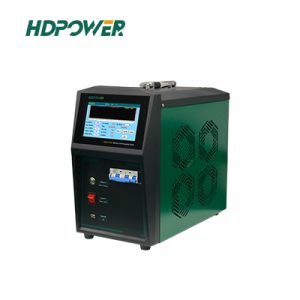
Why Battery Capacity Testing Matters
The rated capacity printed on a battery is not necessarily the capacity available after years of service.
A battery rated at 100 Ah, for example, may no longer be capable of delivering 100 Ah under its specified test conditions. Internal degradation can gradually reduce the amount of energy available to connected equipment.
This becomes particularly important in applications where batteries serve as backup power.
Common examples include:
- UPS systems
- Telecommunications power systems
- Data centers
- Substations
- Power plants
- Railway systems
- Emergency power systems
- Industrial control systems
- Energy storage systems
- Battery maintenance and repair facilities
In these applications, a battery failure may not become obvious until the backup system is actually required.
A capacity test provides a more meaningful picture of battery performance than a simple open-circuit voltage measurement. This is one reason battery discharge testing is used to evaluate the actual capacity of stationary battery systems.
How Does a Battery Capacity Analyzer Work?
The exact procedure depends on the battery chemistry, battery rating, testing objective, and equipment being used. For industrial lead-acid batteries, a typical capacity verification process involves several stages.
- Fully Charge the Battery
The battery should first be charged according to the manufacturer’s recommended charging procedure.
Starting from a known and appropriate state of charge is essential because an incomplete charge can cause the measured capacity to appear lower than the battery’s actual capability.
- Set the Test Parameters
The operator establishes the appropriate discharge parameters, which may include:
- Battery voltage
- Rated capacity
- Discharge current
- Discharge time
- Cut-off voltage
- Number of cells
- Test duration
- Data recording interval
The correct parameters depend on the battery manufacturer’s specifications and the applicable testing procedure.
- Apply a Controlled Load
The battery is connected to a controlled load or electronic discharge system.
During the test, the equipment continuously records voltage and current while the battery supplies energy to the load.
- Monitor Voltage and Current
Battery voltage normally decreases during discharge. Monitoring the voltage of the complete battery and, where required, individual cells can help identify abnormal behavior.
A sudden voltage drop or an individual cell that deviates significantly from the rest of the battery string may indicate a weak cell or other battery problem.
- Stop at the Defined End Point
The discharge test continues until the specified end-of-discharge condition is reached.
The end point must be selected according to the battery manufacturer’s requirements and the applicable testing procedure. Stopping at an inappropriate voltage can produce misleading capacity results or unnecessarily stress the battery.
- Calculate the Delivered Capacity
The test equipment records the current delivered over time and calculates the resulting capacity, normally expressed in Ah.
The measured value can then be compared with the battery’s rated capacity and historical test results.
This comparison is often more useful than looking at a single test result because it allows maintenance teams to monitor capacity degradation over time.
Battery Capacity vs. Battery Voltage
One of the most common mistakes in battery maintenance is treating voltage as a direct measurement of capacity.
Voltage can provide useful information about battery condition, but it does not directly tell you how much usable capacity remains.
Two batteries can show similar voltage readings while having substantially different capacity.
For example, an aging battery may maintain an apparently normal voltage when lightly loaded but experience a rapid voltage decline once a substantial load is applied.
This is why a professional battery testing program may combine several measurements rather than relying on voltage alone.
These measurements can include:
- Voltage
- Discharge current
- Discharge duration
- Delivered capacity
- Internal resistance
- Individual cell voltage
- Temperature
- Historical test data
A Battery Capacity Analyzer or battery test system can bring these measurements together to provide a more complete picture of battery condition.
Capacity Testing and Discharge Testing
For actual capacity verification, discharge testing is particularly important.
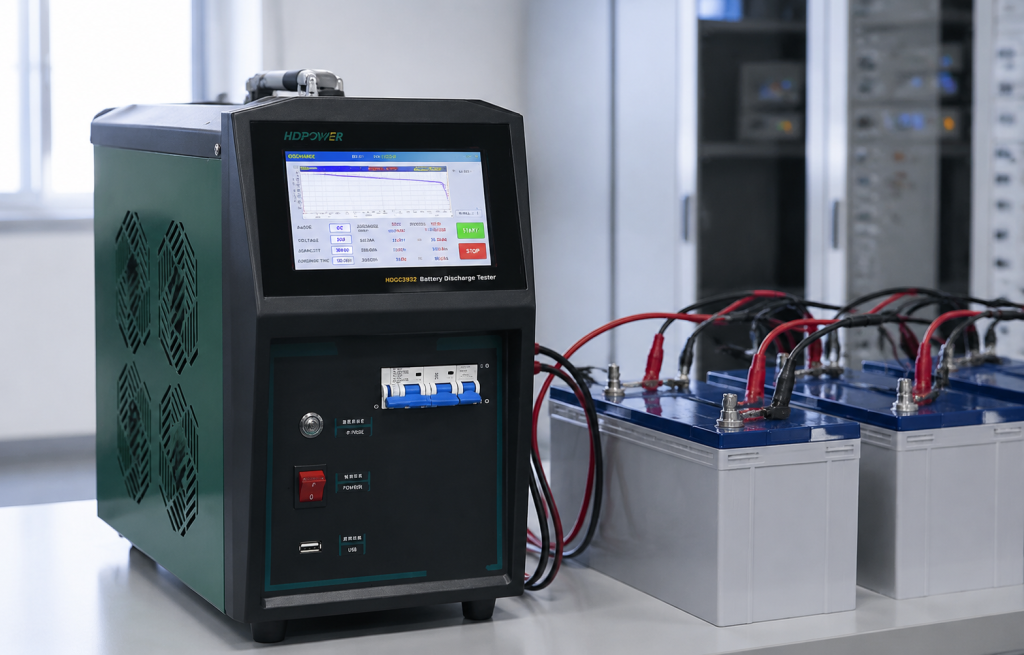
A controlled discharge places a defined electrical load on the battery while the test instrument records the battery’s response. The resulting discharge curve and delivered capacity provide direct information about the battery’s ability to supply energy.
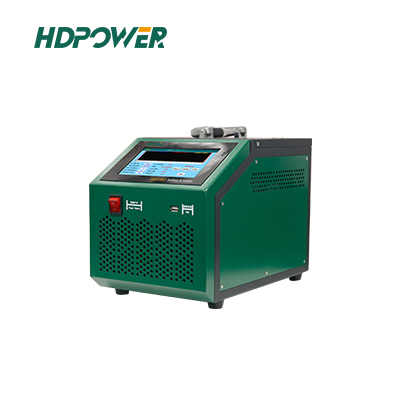
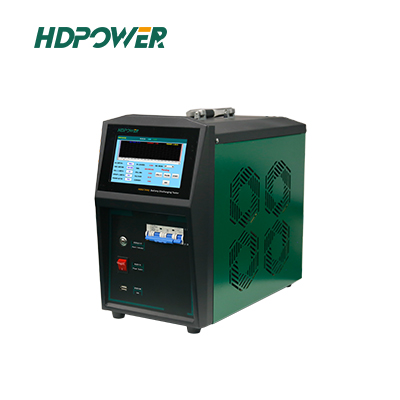
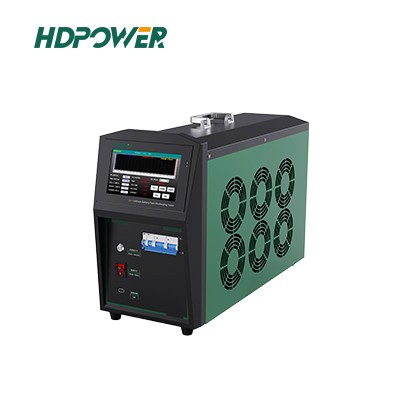
Our Battery Discharge Tester solutions can be used for controlled battery discharge and capacity verification in industrial battery applications.
This approach is especially valuable for:
- Commissioning new battery banks
- Periodic maintenance
- Acceptance testing
- Capacity verification
- Troubleshooting
- Battery replacement evaluation
- Comparing aging battery strings
- Checking batteries after repair or maintenance
Industrial discharge test systems are specifically designed to determine actual battery capacity and can also monitor individual cell voltages during the test when combined with suitable monitoring equipment.
Why Internal Resistance Testing Should Also Be Considered
Capacity testing tells you how much energy a battery can deliver under the defined test conditions. Internal resistance testing provides another important indication of battery condition.
A battery may still deliver acceptable capacity while showing signs of increasing internal resistance. Conversely, abnormal internal resistance can help identify weak or deteriorating cells before a major capacity failure occurs.
This makes internal resistance measurement a useful complementary diagnostic method.
For fast field diagnostics, our Battery IR Tester can help maintenance personnel measure battery internal resistance and identify abnormal cells or connections.

Using capacity testing together with internal resistance testing can provide a more complete assessment than either method alone.
Capacity Testing vs. Internal Resistance Testing
| Test Method | Main Purpose | Typical Application |
| Capacity Test | Determine actual delivered capacity | Battery performance verification |
| Discharge Test | Measure battery performance under controlled load | UPS and industrial battery banks |
| Internal Resistance Test | Identify abnormal resistance and weak cells | Routine battery diagnostics |
| Voltage Test | Check electrical voltage condition | Quick preliminary inspection |
| Temperature Measurement | Identify abnormal thermal conditions | Battery maintenance and monitoring |
The important point is that these methods are complementary rather than interchangeable.
Can Battery Activation Improve a Capacity Test Result?
For lead-acid batteries, reduced capacity does not always mean that the battery must immediately be replaced.
Sulfation, prolonged undercharging, stratification, and other conditions can contribute to reduced battery performance. In some maintenance scenarios, battery activation may be considered before final replacement decisions are made.
A Lead Acid Battery Activator can be used as part of a battery restoration and maintenance process for suitable lead-acid batteries.
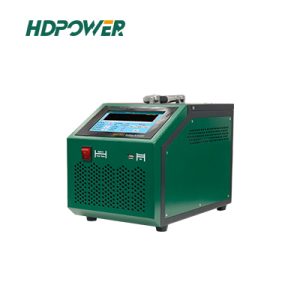
After activation or maintenance, the battery can be tested again to determine whether its measurable performance has improved.
This creates a useful maintenance cycle:
Test → Diagnose → Activate/Maintain → Retest → Evaluate
The important point is that activation should not be treated as a substitute for capacity testing. A battery should be retested after maintenance so that the actual performance improvement can be verified rather than assumed.
What Factors Affect Measured Battery Capacity?
Battery capacity is influenced by more than battery age.
Important factors include:
Battery Temperature
Battery performance varies with temperature. Testing conditions should therefore be considered when comparing capacity results.
Discharge Rate
The discharge current can significantly influence the measured capacity of a battery. The test rate should be selected according to the applicable battery specification and test procedure.
Battery Age
As batteries age, their available capacity generally decreases because of chemical and physical degradation.
Charging History
Repeated undercharging, overcharging, or improper charging can contribute to battery deterioration.
Operating Environment
High temperature, poor ventilation, vibration, and other environmental conditions can affect battery service life and performance.
Individual Cell Condition
In a series-connected battery string, one weak cell can affect the performance of the entire system.
This is why professional testing should look beyond a single voltage measurement.
How to Choose a Battery Capacity Testing System
When selecting a battery capacity testing solution, consider the following factors.
- Battery Voltage Range
Make sure the equipment supports the voltage of the battery or battery bank you need to test.
- Discharge Current
The maximum discharge current should be appropriate for the battery capacity and required testing procedure.
- Testing Method
Determine whether you need:
- Rapid diagnostic testing
- Internal resistance measurement
- Controlled discharge testing
- Capacity verification
- Charge-discharge cycling
- Battery activation
- Individual cell monitoring
- Data Recording
For professional maintenance, automatic data recording is highly valuable.
A useful testing system should make it easy to record voltage, current, capacity, test duration, and other relevant parameters.
- Report Generation
For industrial applications, test reports can provide important documentation for maintenance records, acceptance testing, and replacement decisions.
- Battery Chemistry
Always confirm that the equipment is appropriate for the battery chemistry being tested, such as lead-acid or lithium-ion batteries.
- Application Environment
A portable tester may be suitable for field diagnostics, while a high-current discharge system may be more appropriate for large stationary battery banks.
Battery Capacity Testing for UPS and Backup Power Systems
UPS batteries require special attention because they may remain on standby for long periods and only be called upon during a power interruption.
A battery can appear healthy during normal operation but have insufficient capacity to support the required load during an outage.
Regular testing can help maintenance teams identify capacity degradation before an actual emergency occurs.
For UPS and stationary battery systems, a comprehensive testing strategy may include:
- Visual inspection
- Voltage measurement
- Internal resistance testing
- Controlled discharge testing
- Capacity comparison
- Individual cell analysis
- Maintenance or activation when appropriate
- Retesting
- Historical data comparison
This approach provides a much stronger basis for maintenance decisions than relying on voltage alone.
Battery Capacity Testing for Lead-Acid Batteries
Lead-acid batteries remain widely used in UPS systems, telecommunications, substations, emergency power systems, and other stationary applications.
Their capacity can gradually decline because of aging and operating conditions, making periodic testing important for critical installations.
For these systems, a battery capacity test should be performed under controlled and documented conditions. The resulting data can be compared with previous tests to identify performance trends.
Where a battery shows reduced performance, maintenance personnel can combine capacity data with internal resistance measurements and other diagnostic information to determine whether the battery should be maintained, restored, monitored more closely, or replaced.
Capacity Testing Is More Than a Single Number
The final capacity value is important, but the test data behind that number can be even more valuable.
A professional battery test can generate a discharge curve showing how voltage changes throughout the test. Abnormal curves may reveal problems that would not be obvious from the final Ah value alone.
Historical data can also show whether a battery is:
- Maintaining stable capacity
- Gradually losing capacity
- Experiencing accelerated degradation
- Developing weak cells
- Responding positively to maintenance
For organizations managing large numbers of batteries, consistent data collection can turn individual tests into a long-term battery maintenance strategy.
Build a More Complete Battery Testing Strategy
No single measurement can describe every aspect of battery health.
A practical industrial testing strategy can combine several complementary technologies:
Battery Capacity Testing
Determines how much capacity the battery can actually deliver.
Battery Discharge Testing
Applies a controlled load to verify battery performance under defined conditions.
Internal Resistance Testing
Helps identify abnormal cells and electrical connections.
Battery Activation
Can be used as part of a maintenance or restoration process for suitable lead-acid batteries.
Together, these methods can provide a more comprehensive view of battery condition.
Conclusion
A Battery Capacity Analyzer can be an important tool for evaluating whether a battery can still deliver the performance required by its application. However, the meaning of “capacity analyzer” depends on the testing method. Rapid diagnostic instruments may estimate remaining capacity from electrical characteristics, while controlled discharge systems can directly verify delivered capacity.
For critical industrial and backup power applications, the most reliable approach is to combine capacity testing with complementary measurements such as internal resistance, voltage monitoring, and appropriate battery maintenance.
Whether you are testing UPS batteries, telecom battery banks, stationary lead-acid batteries, or other industrial battery systems, the goal should be the same: replace assumptions with measurable, repeatable battery performance data.
A well-designed battery testing program helps maintenance teams detect degradation earlier, make better replacement decisions, document battery performance, and reduce the risk of unexpected backup power failure.