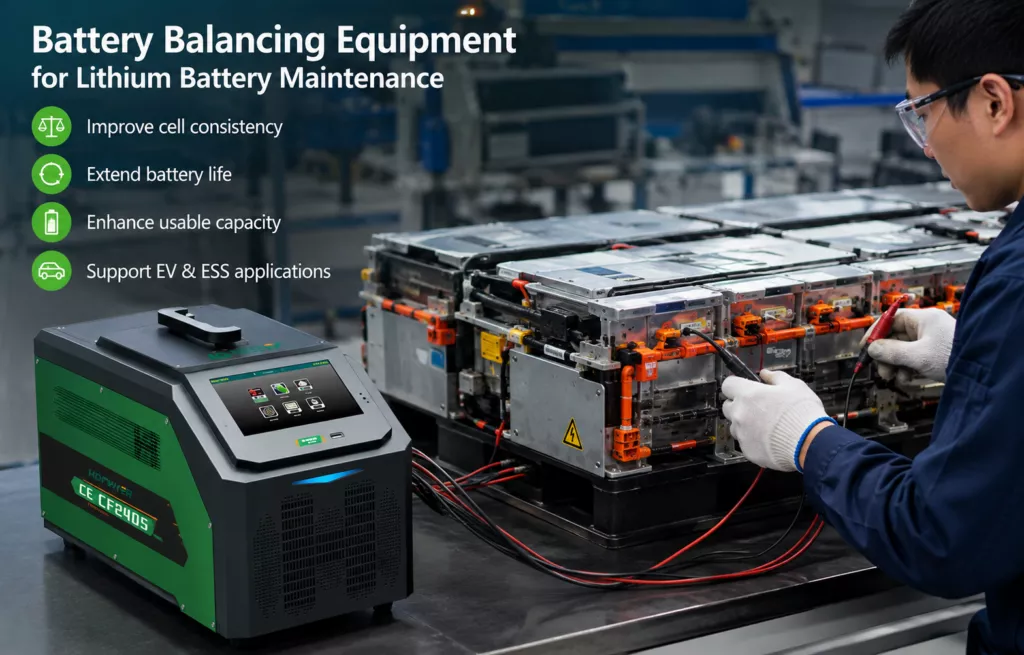
Lithium battery modules are widely used in electric vehicles, industrial energy storage systems, commercial backup power and other applications requiring reliable energy supply. As these battery systems operate through repeated charge and discharge cycles, differences in individual cell performance can gradually become more noticeable. Voltage deviation, inconsistent capacity and varying internal resistance may affect the overall performance of a battery module.
For battery repair centers, EV service providers and energy storage maintenance companies, identifying and correcting cell imbalance is an important part of battery maintenance. However, conventional balancing methods may not provide sufficient flexibility or measurement consistency when technicians need to work with complex battery module configurations.
This is where independent-channel lithium battery balancing becomes particularly valuable. By allowing separate channels to perform balancing operations independently, professional equipment can improve maintenance flexibility, reduce interference between working channels and support more controlled battery module servicing.
This article explains how independent-channel architecture works, which technical specifications matter, and how to select suitable balancing equipment for professional battery maintenance applications.
1. Why Battery Cell Imbalance Matters in Lithium Battery Modules
A lithium battery pack consists of multiple cells connected in series, parallel or a combination of both. Although cells may come from the same production batch, their actual characteristics are not always identical.
During operation, several factors can contribute to cell imbalance:
- Differences in initial cell capacity and internal resistance.
- Unequal temperature distribution within the battery module.
- Different charging and discharging conditions.
- Long-term cycling and natural cell aging.
- Inconsistent self-discharge rates.
- Variations in manufacturing quality and operating environments.
When cells develop different voltage characteristics, the battery management system (BMS) may detect abnormal voltage deviations. Depending on the battery design and operating conditions, an individual cell may reach its upper or lower voltage limit earlier than other cells.
This can restrict the usable operating range of the entire module, even when some cells still have available capacity.
For EV battery repair facilities, these differences can complicate battery diagnosis and module refurbishment. In energy storage systems, inconsistent cell conditions can also make maintenance planning more difficult.
However, voltage imbalance should not automatically be interpreted as proof of permanent cell failure. It may indicate differences in state of charge, capacity, temperature, internal resistance or other underlying conditions. Proper diagnosis should therefore precede any balancing operation.
2. What Is Independent-Channel Lithium Battery Balancing?
Independent-channel lithium battery balancing refers to a balancing architecture in which multiple working channels operate with separate control and measurement functions.
Instead of treating all connected battery strings as one undifferentiated working circuit, independent-channel equipment manages the assigned battery connections through separate channels.
This architecture is particularly useful when technicians need to maintain multiple battery strings or work with modules that have different voltage conditions.
For professional battery maintenance applications, selecting the right Lithium Battery Equalizing Tester is essential for managing different battery module configurations and achieving consistent maintenance results.
Its practical advantages include:
Separate channel operation
Each channel can manage its assigned battery connection according to the equipment’s control strategy. This makes it easier to organize maintenance tasks involving multiple battery strings.
Reduced channel interference
Independent channel design helps reduce unwanted interaction between working channels. This is important when multiple battery sections are being tested or balanced simultaneously.
More flexible maintenance arrangements
Different battery modules may require different maintenance procedures. Independent channels provide greater flexibility when configuring equipment for different module structures.
Improved maintenance efficiency
For professional service centers, handling several battery sections through a suitable multi-channel arrangement can help organize workflows and reduce unnecessary manual switching.
It is important to understand that independent-channel architecture does not automatically guarantee better balancing results. Actual performance also depends on measurement accuracy, current control, wiring quality, battery condition and the equipment’s operating strategy.
3. Independent Channels vs. Conventional Multi-Channel Designs
Not all multi-channel battery maintenance equipment uses the same architecture.
Some systems share measurement or control resources between channels, while others provide more independent channel management. The difference becomes important when multiple battery strings have different operating conditions.
| Evaluation Item | Shared-Resource Design | Independent-Channel Design |
|---|---|---|
| Channel management | Shared control resources | Separate channel management |
| Measurement interaction | Depends on system architecture | Designed to reduce channel interference |
| Maintenance flexibility | Depends on configuration | Suitable for separate battery sections |
| Multi-string applications | Depends on system capacity | Supports organized multi-channel workflows |
| Application suitability | General maintenance | More demanding module maintenance tasks |
The actual design should always be verified through the manufacturer’s technical documentation.
For battery maintenance companies, the most important question is not simply how many channels a machine provides. Buyers should also understand whether those channels can operate independently under the intended working conditions.
A machine with more channels is not necessarily the better choice if its control architecture, measurement accuracy or supported battery configuration does not match the application.
4. Key Technical Specifications When Selecting Balancing Equipment
For professional battery repair and maintenance applications, equipment selection should be based on measurable technical specifications rather than marketing descriptions alone.
4.1 Voltage Measurement Accuracy
Voltage measurement accuracy is one of the most important factors in battery balancing.
When the voltage differences between individual cells are relatively small, measurement errors may affect the assessment of cell consistency and the evaluation of balancing progress.
For example, a system with ±2mV voltage accuracy provides a finer measurement capability than equipment with a wider measurement tolerance.
However, buyers should also examine measurement resolution, measurement stability, calibration procedures and the conditions under which the specified accuracy is achieved.
These details help determine whether the equipment is suitable for professional battery module maintenance.
4.2 Current Measurement and Control Accuracy
Current measurement is another important consideration.
Balancing operations involve controlled current flow between battery cells or through designated charging and discharging paths, depending on the equipment architecture.
Inaccurate current measurement may make it more difficult to evaluate the balancing process and compare maintenance results.
For applications requiring precise monitoring, buyers should check current measurement accuracy and control stability. Equipment offering ±50mA current accuracy, for example, provides a clearly defined measurement specification that can be evaluated against project requirements.
4.3 Independent Channel Configuration
The required number of channels depends on the battery module structure and the maintenance workload.
Before purchasing equipment, confirm:
- The number of independent working channels.
- The supported number of battery strings.
- Whether channels can operate simultaneously.
- Whether each channel has independent measurement and control.
- Whether the equipment supports the required cell connection arrangement.
These details are especially important for EV battery repair facilities and energy storage service providers working with different battery module configurations.
4.4 Battery Chemistry Compatibility
Different lithium battery chemistries have different voltage characteristics and operating requirements.
Two common types are:
- Lithium Iron Phosphate (LiFePO4 or LFP).
- Nickel Manganese Cobalt (NMC).
Equipment should support the battery chemistry and voltage range specified for the target application.
Technicians should never apply the same voltage limits or balancing parameters to different battery chemistries without checking the manufacturer’s battery specifications.
4.5 Protection and Operating Safety
Battery maintenance equipment must be selected with appropriate protection functions.
Important considerations include overvoltage protection, undervoltage protection, overcurrent protection, abnormal connection detection and temperature-related safeguards where supported.
The equipment should also provide clear operating instructions and alarm indications.
In professional environments, a well-defined operating procedure is just as important as the equipment itself.
5. Why Depolarization Matters in Battery Module Maintenance
Another technical consideration in lithium battery balancing is voltage rebound.
After charging, discharging or balancing operations, a cell’s measured terminal voltage may change as electrochemical conditions gradually stabilize.
This phenomenon can complicate the evaluation of battery cell consistency, particularly when technicians compare voltage readings immediately after different maintenance operations.
A balancing process that focuses only on reaching a temporary voltage target may not provide sufficient information about the stability of the final result.
Depolarization-related processing can help address this issue by reducing polarization effects and supporting more stable voltage evaluation.
For professional maintenance applications, technicians should consider:
- Whether the equipment provides a defined depolarization function.
- How the process is integrated into the balancing procedure.
- Whether voltage readings are evaluated after an appropriate stabilization period.
- Whether the results are consistent across repeated measurements.
Depolarization should not be confused with repairing a physically damaged or chemically degraded cell. It is a technical process intended to improve the reliability of battery maintenance and evaluation.
6. Applications of Independent-Channel Balancing Equipment
Independent-channel equipment is particularly relevant to organizations that handle lithium battery modules as part of regular testing, repair or maintenance operations.
EV Battery Repair Centers
Electric vehicle battery repair facilities often need to diagnose battery modules with different voltage conditions.
Independent-channel balancing equipment can support organized maintenance of multiple battery sections, helping technicians perform controlled balancing operations during module refurbishment.
It can also be useful for service providers that handle different battery configurations and require flexible equipment arrangements.
Energy Storage System Maintenance
Commercial and industrial energy storage systems contain numerous battery modules and strings.
Over time, differences in operating conditions may lead to inconsistent cell characteristics.
Maintenance providers can use suitable balancing equipment as part of a broader diagnostic and maintenance procedure.
The equipment configuration should match the battery architecture, chemistry and manufacturer’s maintenance requirements.
Battery Module Manufacturers
Battery manufacturers and module assembly facilities may require balancing equipment during production verification, module conditioning or quality-control procedures.
Independent channels can provide a more organized way to handle multiple battery sections, depending on production requirements and equipment configuration.
Battery Refurbishment and Second-Life Applications
Battery refurbishment companies need to evaluate the condition of used battery modules before determining their suitability for further applications.
Balancing equipment can support the maintenance stage, but it should be combined with capacity testing, internal resistance evaluation, insulation checks and other necessary diagnostic procedures.
Balancing alone cannot establish whether a used battery is safe or suitable for second-life deployment.
7. How to Choose the Right Equipment for Different Battery Projects
Different buyers have different requirements. A repair workshop handling individual EV battery modules may need a different configuration from a manufacturer maintaining multiple battery strings.
A practical selection process should include the following steps.
Step 1: Define the battery chemistry and voltage range
Identify whether the target batteries are LFP, NMC or another supported chemistry. Confirm the minimum and maximum working voltage.
Step 2: Determine the module and string configuration
Check the number of cells in series, the number of strings and the required connection arrangement.
Do not select equipment based solely on the total battery voltage.
Step 3: Establish the required channel capacity
Estimate how many battery sections need to be handled simultaneously.
Consider both current workload and potential future expansion.
Step 4: Compare measurement specifications
Evaluate voltage accuracy, current accuracy, measurement stability and calibration requirements.
Ask manufacturers to clarify the test conditions associated with their specifications.
Step 5: Check operating functions and protection
Confirm supported balancing modes, depolarization functions, alarm systems, data recording and safety protections.
Step 6: Evaluate technical support and customization
For international buyers, technical documentation, remote support, training and configuration assistance can be important factors in long-term equipment operation.
A professional supplier should be able to explain how the equipment matches the actual battery application instead of recommending a model based only on its channel count.
8. HDPOWER CE-CF Series: Independent-Channel Lithium Battery Balancing Solutions
HDPOWER develops lithium battery testing and maintenance equipment for battery service providers, manufacturers and energy storage applications.
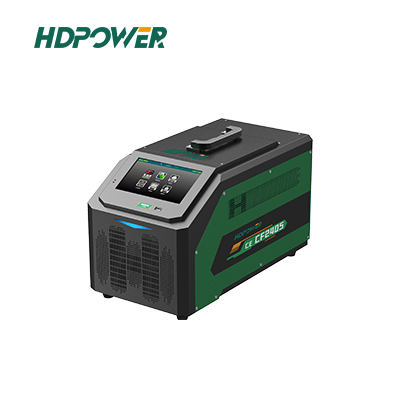
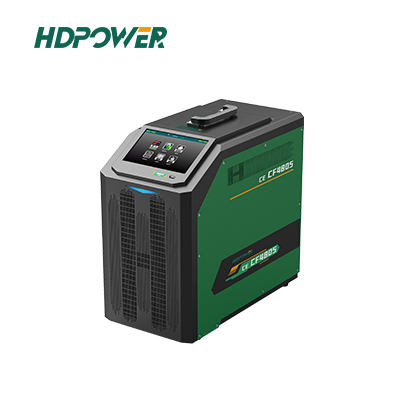
The CE-CF series lithium battery balancing testers are designed for professional battery module maintenance, with an emphasis on measurement precision, independent channel architecture and practical operating functions.
For projects requiring a 24-cell configuration, the CE-CF24 Lithium Battery Equalizing Tester provides a dedicated solution for lithium battery module balancing, charging, discharging and maintenance.
For larger battery module configurations, buyers can also explore the CE-CF72 Lithium Battery Equalizing Tester to evaluate a 72-cell configuration for their maintenance requirements.
Key technical features include:
- Voltage measurement accuracy of ±2mV.
- Current measurement accuracy of ±50mA.
- Independent channel design to reduce interaction between working channels.
- Depolarization-related processing to help address voltage rebound.
- Support for LiFePO4 and NMC battery applications.
- Touchscreen operation and practical maintenance functions.
- Different configurations for varying battery module and string requirements.
The series includes different configurations to address different application needs. Buyers should confirm the supported channel count, battery string configuration, voltage range and operating current for the specific model before ordering.
For battery repair centers, the equipment can support module balancing and maintenance workflows. For energy storage service providers, it can help technicians manage battery sections during planned maintenance. For battery manufacturers, it can provide a specialized tool for relevant module-level processes.
Beyond balancing solutions, HDPOWER provides a comprehensive range of Lithium Battery Test Device for battery charging, discharging, cell testing and battery pack maintenance.
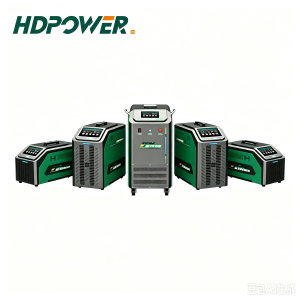
Selecting the right combination of equipment allows buyers to establish a more complete battery testing and maintenance workflow.
9. What International Buyers Should Confirm Before Purchasing
For overseas customers, selecting a suitable battery balancing tester involves more than comparing product prices.
Before placing an order, professional buyers should request the following information:
- Complete technical specifications and supported battery chemistries.
- Independent channel architecture and wiring diagrams.
- Supported cell and string configurations.
- Voltage and current measurement accuracy.
- Operating procedures and protection functions.
- Product manuals and technical documentation.
- Warranty terms, spare parts availability and after-sales support.
- Customization options for specific battery applications.
If the equipment will be integrated into an existing production or repair process, buyers should also discuss communication requirements, data export and compatibility with their current maintenance procedures.
These checks help reduce configuration misunderstandings and make it easier to evaluate different equipment suppliers.
Conclusion
As lithium battery applications become more diverse, battery maintenance providers need equipment that can handle increasingly complex module configurations with greater measurement precision and operational flexibility.
Independent-channel lithium battery balancing provides an important approach for managing multiple battery sections while reducing unwanted interaction between working channels.
However, the right equipment should be selected through a comprehensive evaluation of measurement accuracy, channel architecture, battery chemistry compatibility, depolarization functions and safety requirements.
For EV battery repair centers, energy storage maintenance companies and battery module manufacturers, investing in suitable balancing equipment can help establish more consistent and efficient maintenance procedures.
HDPOWER provides CE-CF series lithium battery balancing solutions for professional battery maintenance applications. Contact our technical team with your battery chemistry, voltage range, cell configuration and required channel capacity to discuss a suitable equipment configuration.