-
Introduction
Lithium battery packs are widely used in electric vehicles, energy storage systems, industrial equipment, and other high-power applications. During operation, maintenance, performance evaluation, and recycling, controlled discharge is an important process for managing the electrical energy stored inside a battery pack.
One of the most important parameters in this process is the lithium battery pack discharge cut-off voltage. It defines the lower voltage boundary at which a discharge process must stop according to the battery manufacturer’s specifications and the requirements of the testing procedure.
An inappropriate discharge limit can affect test accuracy, battery condition, and operational safety. If the discharge process continues beyond the permitted voltage range, individual cells may experience excessive voltage reduction, potentially resulting in irreversible performance degradation or other safety concerns.
However, there is no single cut-off voltage suitable for every lithium battery. Different chemistries, cell configurations, operating temperatures, and battery management strategies require different limits.
For battery manufacturers, EV service centers, and recycling facilities, understanding these differences is essential when selecting discharge testing equipment and establishing standardized procedures.
This article explains the principles of lithium battery discharge voltage limits, the factors that influence them, and how professional battery discharge equipment supports controlled testing.
-
What Is Lithium Battery Pack Discharge Cut-Off Voltage?
Discharge cut-off voltage refers to the minimum permitted voltage at which a battery discharge operation should terminate under a specified operating condition.
During discharge, a lithium battery releases stored electrical energy to an external load. As energy is consumed, the battery’s terminal voltage generally decreases.
When the voltage reaches the defined lower limit, the discharge process must stop to prevent excessive discharge.
For an individual lithium-ion cell, the manufacturer’s specified lower voltage limit is determined by its chemistry and design. For a complete battery pack, the corresponding voltage limit depends on the number of cells connected in series and the electrical characteristics of the pack.
For example, a battery pack containing multiple cells in series has a total voltage that reflects the combined voltage of those cells. However, the total pack voltage alone does not always indicate whether every individual cell remains within its permitted operating range.
This distinction is particularly important when testing large-capacity EV battery packs.
A professional discharge procedure should therefore consider:
- Battery chemistry and cell specifications.
- Total pack voltage and series-cell configuration.
- Individual cell voltage limits, where monitoring is available.
- Manufacturer-defined discharge conditions.
- Battery management system (BMS) protection thresholds.
- Required discharge current and power.
Understanding these parameters helps engineers establish appropriate discharge limits before starting a test.
-
Why Is the Discharge Voltage Limit Important?
The discharge voltage limit affects both battery protection and the reliability of test results.
3.1 Preventing Excessive Discharge
Lithium batteries are designed to operate within defined voltage ranges. Discharging below the permitted lower limit may cause undesirable electrochemical reactions and permanent capacity degradation.
In severe cases, excessive discharge can increase internal damage and create additional risks during subsequent charging or operation.
A properly established termination condition helps prevent the discharge process from continuing beyond the battery’s permitted operating range.
3.2 Maintaining Battery Performance
Battery performance evaluation requires consistent testing conditions.
If different battery packs are discharged to different voltage limits, their measured discharge capacities may not be directly comparable.
For example, two battery packs tested under the same current but with different termination voltages may produce different capacity results simply because the discharge endpoints are different.
Using a defined cut-off condition helps improve the repeatability of battery performance tests.
3.3 Supporting Battery Maintenance and Recycling
Retired EV battery packs may still contain considerable stored electrical energy.
Before maintenance, dismantling, or recycling operations, facilities need to establish appropriate electrical energy management procedures.
A controlled discharge process can help reduce the remaining electrical energy under specified conditions. However, reaching a particular pack voltage does not automatically make a battery safe to dismantle.
Technicians must also follow applicable isolation, verification, handling, and high-voltage safety procedures.
-
What Factors Affect Lithium Battery Discharge Cut-Off Voltage?
The correct discharge limit depends on several technical factors. Engineers should evaluate the complete battery system rather than selecting a value based only on nominal voltage.
4.1 Battery Chemistry
Different lithium battery chemistries have different voltage characteristics.
Common examples include:
- Lithium Iron Phosphate (LFP)
- Nickel Manganese Cobalt (NMC)
- Other lithium-ion chemistries
LFP batteries generally have a relatively flat discharge voltage profile over much of their operating range, while NMC batteries typically exhibit a different voltage curve.
Consequently, their recommended lower voltage limits may differ.
Even batteries using the same chemistry can have different specifications depending on cell design and manufacturer requirements.
Engineers should always refer to the original cell or battery pack datasheet rather than applying a universal voltage threshold.
4.2 Number of Cells Connected in Series
The total voltage of a battery pack is influenced by the number of cells connected in series.
For a simplified series configuration:
Pack Voltage = Number of Series Cells × Individual Cell Voltage
This relationship helps engineers understand the approximate pack voltage corresponding to a specified cell voltage.
However, this calculation assumes that individual cells have similar voltage characteristics. In actual battery packs, cell imbalance can cause differences between individual cell voltages.
Therefore, a pack-level voltage measurement should not automatically be treated as proof that every cell is operating within its permitted range.
4.3 Discharge Current
Discharge current also affects the measured battery voltage.
Under load, the terminal voltage can decrease because of internal resistance and electrochemical polarization.
At higher discharge currents, the voltage drop may become more pronounced.
This means that a battery pack may reach its voltage termination condition earlier under a higher-current test than under a lower-current test.
For accurate evaluation, the discharge current and termination voltage should be specified together.
4.4 Operating Temperature
Temperature influences battery performance and electrical characteristics.
Low temperatures can increase internal resistance and reduce available discharge capacity. High temperatures may accelerate degradation and increase thermal management requirements.
Battery manufacturers typically specify operating temperature limits and recommended discharge conditions.
Testing facilities should ensure that the battery and discharge equipment operate within their respective permitted temperature ranges.
4.5 Battery Condition and Aging
Battery aging, cell imbalance, and internal resistance differences can affect the discharge behavior of a battery pack.
An aged pack may experience a larger voltage drop under load than a newer pack.
If one cell reaches its lower voltage limit earlier than the others, the entire battery pack may need to stop discharging even though its total voltage still appears acceptable.
This is why voltage behavior should be evaluated together with other available battery condition information.
-
How to Determine the Appropriate Discharge Termination Voltage
Establishing an appropriate discharge limit requires a structured approach.
The following considerations can help battery engineers and testing technicians develop a consistent procedure.
Step 1: Identify the Battery Chemistry
Confirm whether the battery uses LFP, NMC, or another lithium-ion chemistry.
Different chemistries have different operating voltage characteristics and manufacturer-defined limits.
Step 2: Check the Manufacturer’s Specifications
Review the battery datasheet and technical documentation.
Important information includes:
- Minimum permitted cell voltage.
- Recommended discharge current.
- Operating temperature range.
- Maximum and minimum pack voltage.
- BMS protection thresholds.
These values should form the basis of the testing procedure.
Step 3: Confirm the Pack Configuration
Determine the number of cells connected in series and the pack’s electrical configuration.
This information helps engineers establish the relationship between individual cell voltage and total pack voltage.
Step 4: Define the Test Conditions
Specify the discharge current or power, expected test duration, and termination requirements.
The testing conditions should be appropriate for the battery’s condition and intended application.
Step 5: Verify the Measurement System
Check that the voltage and current measurement equipment has suitable measurement ranges and accuracy.
Where individual cell monitoring is required, ensure that the corresponding monitoring system is correctly configured.
Step 6: Establish the Stop Conditions
Configure the discharge procedure according to the battery manufacturer’s requirements and the applicable operating standards.
The process should stop when the defined termination condition is reached or when a protection event requires the test to be interrupted.
This approach helps improve test consistency while reducing the risk of excessive discharge.
-
Constant Current vs. Constant Power Discharge
The selected discharge mode can influence how battery voltage and current behave throughout a test.
Two commonly used modes are constant current (CC) and constant power (CP).
Constant Current Discharge
In constant current mode, the discharge equipment maintains a specified current within its operating limits.
As battery voltage gradually decreases, the discharge power also changes.
The relationship is:
Power (W) = Voltage (V) × Current (A)
Constant current discharge is useful when a testing procedure requires a stable current throughout the discharge period.
It is commonly applied in battery performance evaluation and controlled capacity testing.
Constant Power Discharge
In constant power mode, the equipment maintains a specified power level within its rated operating range.
As battery voltage changes, the discharge current adjusts accordingly.
The relationship is:
Current (A) = Power (W) ÷ Voltage (V)
For example, when the voltage decreases while the power setting remains unchanged, the required current increases.
This makes it important to verify that the equipment can support the required current throughout the intended voltage range.
Which Mode Should Be Selected?
Neither mode is universally better.
The selection depends on the purpose of the test, battery specifications, and required operating conditions.
Constant current mode is suitable for procedures requiring a defined current, while constant power mode is useful when the required load is expressed as a power level.
In both cases, the discharge termination conditions must remain consistent with the battery manufacturer’s requirements.
-
Common Challenges in High-Voltage Battery Pack Discharge Testing
Testing large lithium battery packs presents several challenges that are not always encountered when testing individual cells.
7.1 Wide Voltage Range
Different EV manufacturers use different battery architectures.
A testing facility may need to handle battery packs with substantially different voltage levels.
Equipment with a wider operating voltage range can reduce the need to use multiple discharge devices for different battery configurations.
7.2 High Discharge Power
Large-capacity battery packs may require significant discharge power.
Selecting equipment based only on maximum current is insufficient. Engineers must also consider the relationship between voltage, current, rated power, and thermal performance.
For example, the maximum current available at a particular voltage may differ depending on the equipment’s power configuration.
7.3 Reliable Voltage Monitoring
Accurate voltage measurement is essential when establishing discharge termination conditions.
Measurement errors, unstable connections, or incorrect configuration can affect test results.
Professional testing equipment should provide appropriate measurement accuracy and operational protection for the intended application.
7.4 Different Battery Conditions
Battery packs entering repair or recycling facilities may vary considerably in age, chemistry, voltage, and condition.
Some may have significant cell imbalance or abnormal electrical characteristics.
These packs should not automatically be tested using the same procedure as healthy batteries.
A preliminary inspection and appropriate risk assessment are necessary before controlled discharge begins.
-
Selecting Professional Lithium Battery Discharge Testing Equipment
Choosing suitable discharge equipment requires more than checking whether it supports a particular battery voltage.
The following specifications should be evaluated.
Voltage Range: Confirm that the equipment supports the battery pack’s maximum operating voltage and the required discharge range.
Discharge Current: Check the available current at the actual operating voltage, not just the maximum value stated in the product brochure.
Rated Power: Ensure that the rated power is suitable for the required discharge workload.
Discharge Modes: Determine whether constant current and constant power modes are needed for different testing procedures.
Measurement Accuracy: Evaluate voltage and current measurement accuracy and resolution.
Protection Functions: Check for appropriate overvoltage, overcurrent, overtemperature, short-circuit, and emergency protection functions.
Cooling and Operating Environment: Confirm that the equipment’s cooling method and environmental specifications match the working conditions.
Portability and Operation: Consider whether the equipment needs to be moved between different battery testing or maintenance areas.
These factors help users select equipment that matches their battery configurations and actual application requirements.
-
HDPOWER CP-F Series for Lithium Battery Pack Discharge
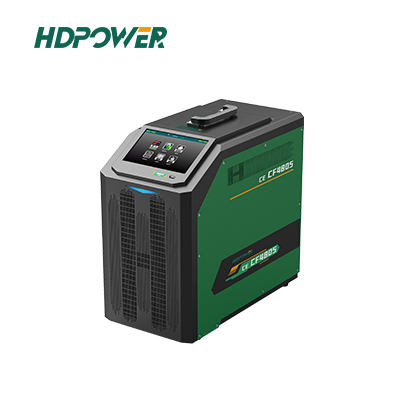
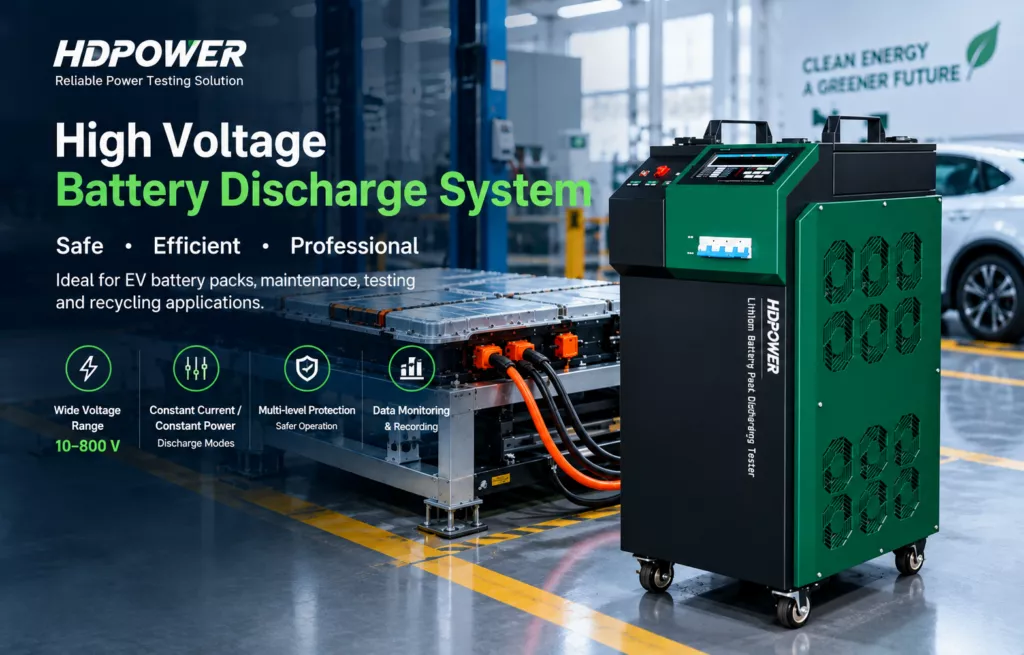
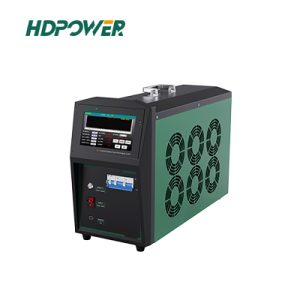
For EV battery service centers, battery manufacturers, and recycling facilities, HDPOWER provides the CP-F series of lithium battery pack discharge testers.
The series is designed for controlled discharge applications involving battery dismantling, storage, transportation, repair, and recycling.
Its wide-voltage design and selectable discharge modes make it suitable for different lithium battery pack configurations.
Key features include:
- Constant current and constant power discharge modes.
- Wide DC voltage compatibility.
- Adjustable discharge operation.
- 7-inch LCD touchscreen.
- Voltage and current measurement.
- Overvoltage, overcurrent, and overtemperature protection.
- External emergency circuit breaker.
- Air-cooling design.
Two available models address different voltage requirements.
CP-F600 Lithium Battery Pack Discharge Tester
The CP-F600 supports a DC voltage range of 10–600V, with available power configurations of 15kW and 30kW.
Its maximum discharge current depends on the selected power configuration and operating voltage.
It is suitable for battery packs within its specified voltage and power range.
CP-F800 Lithium Battery Pack Discharge Tester
The CP-F800 supports a DC voltage range of 10–800V, with available power configurations of 20kW and 40kW.
It provides an option for applications involving higher-voltage battery architectures, including compatible 800V EV battery platforms.
Both models support constant current and constant power discharge, allowing users to select an appropriate operating mode according to their testing requirements.
For detailed specifications, visit the CP-F600 Lithium Battery Pack Discharge Tester and CP-F800 Lithium Battery Pack Discharge Tester product pages.

-
Conclusion
Lithium battery pack discharge cut-off voltage is an important parameter in battery testing, maintenance, and energy management.
An appropriate termination limit depends on battery chemistry, cell configuration, discharge current, operating temperature, and manufacturer-defined requirements.
For high-voltage battery applications, engineers should evaluate both pack-level and individual-cell conditions whenever the required monitoring capabilities are available.
Selecting suitable discharge equipment is equally important. Voltage range, discharge current, rated power, measurement accuracy, operating modes, and protection functions should all be considered.
With appropriate procedures and professional testing equipment, battery service centers, manufacturers, and recycling facilities can achieve more consistent discharge operations and improve the management of lithium battery packs.
HDPOWER’s CP-F600 and CP-F800 provide controlled discharge solutions for different lithium battery pack voltage requirements, supporting professional battery testing, maintenance, and recycling workflows.