-
Why Backup Battery Cell Inspection Matters
Backup battery systems play a critical role in maintaining power continuity across data centers, telecommunications networks, substations, industrial facilities, and other essential infrastructure. When the primary power supply fails, these batteries provide emergency DC power to support critical equipment, protection systems, communication networks, and control operations.
However, the reliability of a battery bank depends not only on its total capacity but also on the condition of every individual cell. A battery string may contain dozens or even hundreds of interconnected cells. Although the entire bank appears to operate normally, one or several deteriorating cells can reduce system reliability and create a potential failure point during an emergency.
This is why backup battery cell inspection is an essential part of preventive maintenance. By examining individual battery cells, maintenance personnel can identify abnormal electrical characteristics, recognize early signs of degradation, and determine which batteries require further investigation.
For industrial battery systems, regular inspection should combine visual checks, terminal inspections, voltage measurements, internal resistance measurements, and appropriate capacity testing. Using portable battery testing equipment allows technicians to perform these checks efficiently at battery installation sites without relying entirely on large laboratory testing systems.
-
What Is Backup Battery Cell Inspection?
Backup battery cell inspection is a systematic process of evaluating individual cells within a battery bank to identify abnormalities that may affect overall system performance.
Unlike a basic battery bank voltage check, which provides information about the combined electrical condition of the string, individual cell inspection helps maintenance teams identify differences between batteries.
For example, a 48V backup battery system may consist of multiple 12V batteries connected in series. Even when the total string voltage appears normal, one battery may have higher internal resistance or a voltage deviation compared with the others.
Such differences can indicate aging, deterioration, poor connections, or other developing problems.
A professional inspection program generally includes several measurement and evaluation methods:
Visual inspection: Checking battery cases, terminals, connections, corrosion, leakage, swelling, and other visible abnormalities.
Voltage measurement: Measuring individual battery voltage and comparing readings across the battery string.
Internal resistance measurement: Evaluating the electrical resistance characteristics of individual batteries to identify abnormal changes.
Conductance measurement: Using conductance readings as an additional diagnostic indicator where supported by the battery chemistry and testing method.
Capacity testing: Conducting controlled discharge testing when a more direct assessment of available battery capacity is required.
These methods provide different types of information. No single measurement should be treated as a complete determination of battery health.
-
Common Warning Signs of Weak Battery Cells
Identifying weak cells before they affect backup power availability is one of the main objectives of industrial battery inspection.
Several warning signs deserve particular attention.
3.1 Abnormal Internal Resistance
Internal resistance is an important indicator used in battery condition assessment. As batteries age or deteriorate, their internal electrical characteristics may change.
A cell with significantly higher internal resistance than comparable cells in the same battery string deserves further investigation.
Possible contributing factors include electrode degradation, sulfation in lead-acid batteries, electrolyte-related problems, and other aging mechanisms.
However, internal resistance readings are influenced by battery type, temperature, state of charge, measurement method, and instrument characteristics. Therefore, maintenance teams should establish reference values for the specific battery model and compare measurements under consistent conditions.
For a more detailed explanation of industrial resistance measurement methods and equipment selection, refer to our guide to Battery Resistance Testing Equipment.
3.2 Unusual Cell Voltage Differences
Voltage inconsistency is another important warning sign.
When individual batteries in the same string show unusual voltage differences under comparable operating conditions, maintenance personnel should investigate the affected units.
A lower-than-expected voltage may be associated with insufficient charging, aging, self-discharge, connection problems, or other battery abnormalities.
Voltage measurements should be interpreted together with internal resistance, operating history, and manufacturer specifications rather than used as the only basis for replacement decisions.
3.3 Corrosion and Connection Problems
Battery terminals and interconnections can also influence system reliability.
Corroded terminals, loose connections, damaged cables, and increased contact resistance may create abnormal voltage drops and localized heating.
These problems can sometimes be mistaken for internal battery deterioration. Therefore, inspection should include both the battery itself and its external electrical connections.
3.4 Abnormal Temperature or Physical Condition
Swelling, leakage, unusual odors, damaged cases, and abnormal temperature differences should never be ignored.
These conditions may indicate serious battery problems and require appropriate safety procedures and technical evaluation.
Electrical measurements cannot replace physical inspection. Both are necessary for a comprehensive maintenance assessment.
-
How to Perform Backup Battery Cell Inspection
A consistent inspection procedure helps improve measurement reliability and makes it easier to compare battery conditions over time.
Step 1: Review Battery Information
Before beginning an inspection, identify the battery chemistry, rated voltage, capacity, installation date, manufacturer, and operating history.
Check available maintenance records and previous measurement reports. Historical information provides a useful reference for identifying changes in battery condition.
Battery specifications are particularly important because acceptable voltage and resistance characteristics vary between different battery models and technologies.
Step 2: Conduct a Visual Inspection
Examine the battery bank and individual batteries for visible abnormalities.
Check battery cases, terminal connections, cables, intercell connectors, ventilation conditions, and signs of corrosion or leakage.
Any damaged battery or suspicious connection should be handled according to the site’s electrical safety procedures.
Step 3: Measure Individual Battery Voltage
Measure the voltage of each battery or cell using an appropriate instrument.
Record the readings and compare them with the manufacturer’s reference values and other batteries operating under similar conditions.
A voltage difference does not automatically indicate battery failure. However, an unusual reading can help identify units that require additional testing.
Step 4: Measure Internal Resistance and Conductance
Use a suitable battery analyzer to measure internal resistance and, where supported, conductance.
These measurements help maintenance personnel compare individual battery characteristics and identify abnormal units within a battery string.
For meaningful comparisons, use the same instrument and measurement method whenever possible. Keep testing conditions consistent and follow the instrument manufacturer’s instructions.
A sudden increase in internal resistance compared with previous records can be an important warning sign, particularly when accompanied by voltage abnormalities or physical symptoms.
Step 5: Compare and Record Results
Organize the collected measurements by battery string and individual battery identification number.
A useful inspection record should include:
- Battery identification and installation location
- Battery model and rated specifications
- Measurement date and operating conditions
- Individual battery voltage
- Internal resistance and conductance readings, where applicable
- Visual inspection observations
- Comparison with previous measurement results
- Recommended follow-up actions
Consistent data recording allows maintenance teams to identify developing trends instead of relying on isolated measurements.
Step 6: Determine Whether Further Testing Is Required
Batteries showing abnormal readings should receive additional evaluation.
Depending on the application, this may include connection checks, charging system inspection, temperature assessment, or controlled capacity testing.
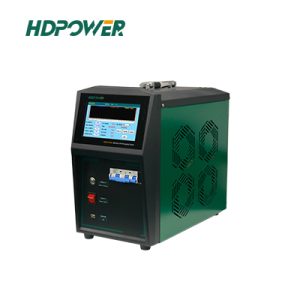
If the battery’s actual available capacity needs to be verified, a properly designed discharge capacity test is more appropriate than relying solely on internal resistance or voltage measurements. Maintenance teams can explore professional Battery Capacity Testing Equipment for more accurate battery capacity verification.
-
Applications in Industrial Backup Power Systems
Backup battery cell inspection is particularly important in facilities where unexpected power interruptions can affect safety, communication, production, or business continuity.
5.1 UPS Battery Systems in Data Centers
Data centers depend on UPS battery banks to maintain power during utility interruptions and generator transfer periods.
A weak battery may compromise the performance of an otherwise properly configured battery string.
Regular individual battery inspection helps maintenance teams identify abnormal units, compare battery conditions, and prioritize further testing before scheduled maintenance windows.
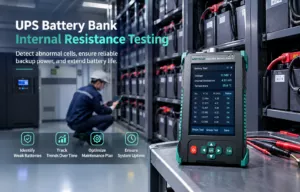
For more information about individual battery resistance measurements in UPS installations, read our technical guide on UPS Battery Bank Internal Resistance Testing.
5.2 Telecommunications Base Stations
Telecommunications base stations use backup batteries to maintain communication services during power outages.
Because base stations may be distributed across many locations, portable inspection instruments are useful for maintenance personnel who need to travel between sites.
Individual battery voltage and internal resistance measurements provide practical information for identifying batteries that require additional attention.
5.3 Substations and Power Plants
Substation DC battery systems supply essential power to protection relays, circuit breaker control circuits, monitoring equipment, and emergency systems.
Battery failure in these applications may affect critical switching and protection operations.
Routine cell-level inspection helps maintenance teams detect abnormal battery characteristics and maintain more complete records of DC backup system conditions.
For maintenance planning, engineers can refer to applicable industry practices, including IEEE 450 for vented lead-acid batteries and IEEE 1188 for valve-regulated lead-acid batteries. These standards address maintenance, testing, and replacement practices for stationary battery applications.
5.4 Industrial DC Power Systems
Industrial facilities, rail transit systems, and other infrastructure applications also rely on backup batteries for essential control and emergency power functions.
A structured inspection program helps maintenance personnel understand battery condition across multiple strings and identify units requiring further investigation.
-
Why Portable Battery Analyzers Improve Inspection Efficiency
Traditional battery maintenance often involves collecting measurements with separate instruments and manually organizing the results.
For facilities with large battery banks or multiple installation sites, this process can become time-consuming.
A portable battery analyzer integrates important measurement functions into one instrument, helping technicians perform battery inspections more efficiently.
When selecting equipment, maintenance teams should consider the following features.
Multiple measurement functions
The instrument should support the electrical parameters required by the maintenance program, such as voltage, internal resistance, and conductance.
Individual and battery group measurement
The ability to measure individual batteries as well as battery groups helps technicians investigate abnormal units and evaluate the overall battery string.
Online and offline testing capability
Online testing can reduce the need to disconnect battery connections during routine inspection. However, the instrument must be suitable for the electrical environment, and the manufacturer’s operating instructions and site safety procedures must always be followed.
Portable design
A compact handheld instrument is convenient for technicians working in battery rooms, substations, telecommunications sites, and data centers.
Data storage and reporting
Storing measurement results and exporting them to computer software makes it easier to compare historical readings, prepare inspection reports, and maintain consistent maintenance records.
HDPOWER provides professional Battery Analyzer Solutions for industrial battery inspection, preventive maintenance, and battery condition assessment across UPS, telecommunications, and power system applications.
-
HDGC3915 Battery Analyzer for Backup Battery Cell Inspection
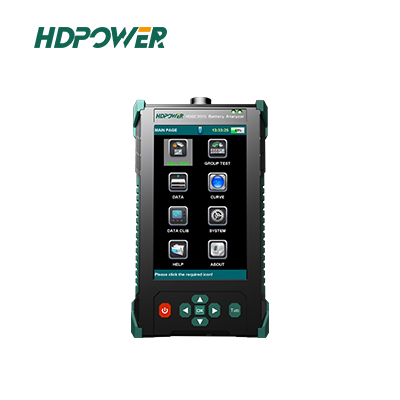
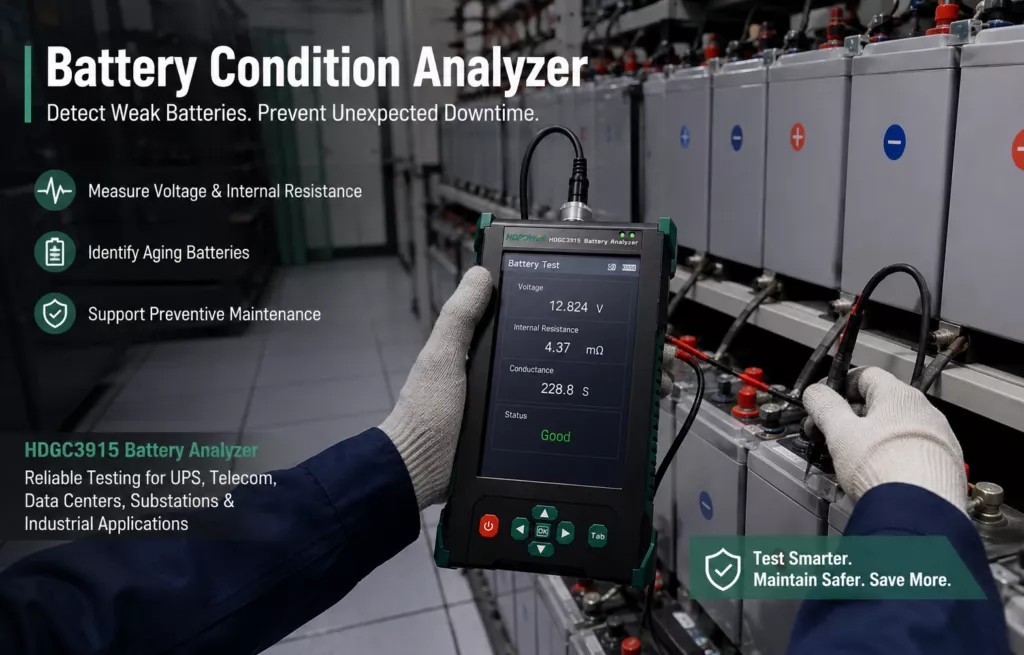
For maintenance teams requiring portable equipment for individual battery inspection, the HDPOWER HDGC3915 Battery Analyzer provides a combination of voltage, internal resistance, and conductance measurement functions.

The instrument uses an AC discharge testing method to measure battery voltage and internal resistance, helping technicians evaluate battery technical condition and identify abnormal batteries.
Its main specifications include:
- Internal resistance measurement range: 0.01 mΩ–120 mΩ
- Voltage measurement range: 1.000 V–25 V
- Conductance measurement range: 20–19,990 S
- Internal resistance measurement accuracy: ±0.5% of reading ±6 digits
- Voltage measurement accuracy: ±0.2% of reading ±6 digits
- Conductance measurement accuracy: ±0.5% of reading ±6 digits
- 5-inch color touchscreen with additional key operation
- Rechargeable lithium battery with up to 10 hours of continuous operation
- Built-in storage and USB data export
- Excel and Word report generation
The HDGC3915 supports both individual battery and battery group measurements. It can also perform online and offline measurements, with anti-interference capability designed for practical battery maintenance environments.
Its handheld design makes it suitable for technicians performing inspections at UPS installations, telecommunications base stations, data centers, power substations, and rail transit facilities.
By recording individual battery readings and comparing them with reference values and historical data, maintenance teams can more efficiently identify batteries that require further evaluation.
The instrument is not a substitute for a controlled capacity discharge test. Instead, it provides practical electrical measurement information to support routine battery inspection and condition assessment.
For organizations seeking to improve their battery maintenance procedures, the HDGC3915 offers a portable approach to collecting and managing important battery condition data.
-
How to Build an Effective Battery Inspection Program
Purchasing a battery analyzer is only one part of a successful maintenance strategy. Consistent inspection procedures and reliable data management are equally important.
A practical program should include the following elements:
Establish battery baselines. Record initial voltage, internal resistance, conductance where applicable, and other relevant information after installation or commissioning.
Create consistent inspection schedules. Determine inspection frequency according to battery type, operating conditions, manufacturer recommendations, system criticality, and applicable standards.
Track changes over time. Compare current measurements with previous results rather than relying on a single reading.
Investigate abnormal cells. Combine electrical measurements with physical inspection, connection checks, charging system evaluation, and additional testing where necessary.
Maintain complete reports. Store inspection results by site, battery string, and individual battery identification to support maintenance planning and replacement decisions.
An effective inspection program should also define responsibilities, measurement procedures, safety requirements, escalation criteria, and documentation practices.
-
Conclusion
Backup battery reliability depends on the condition of individual batteries as well as the overall performance of the battery system.
Regular backup battery cell inspection helps maintenance personnel identify abnormal voltage and resistance characteristics, recognize developing problems, and determine when additional testing or corrective action is necessary.
For UPS systems, telecommunications facilities, substations, data centers, and industrial DC power applications, portable battery analyzers provide a practical way to collect individual battery measurements and maintain inspection records.
With its voltage, internal resistance, and conductance measurement functions, the HDPOWER HDGC3915 Battery Analyzer supports routine battery condition assessment and preventive maintenance.
Combining appropriate testing instruments, consistent inspection procedures, historical data analysis, and established maintenance practices can help organizations improve backup battery reliability and reduce the risk of unexpected power interruptions.
For professional battery inspection and testing solutions, contact HDPOWER to discuss your application requirements and equipment options.