Introduction
A battery bank is a critical component of backup power infrastructure in substations, telecommunications facilities, data centers, industrial plants, and energy storage systems. When the main power supply fails, the battery bank must deliver sufficient energy to keep essential equipment operating. However, a battery bank that appears normal during routine inspections may no longer provide the required backup runtime.
This is why Battery Bank Capacity Assessment is an important part of preventive maintenance and asset management. Rather than relying on a single voltage reading or visual inspection, a comprehensive assessment evaluates the battery’s ability to deliver usable energy, identifies potential weak cells, and helps maintenance teams determine whether further testing, maintenance, or replacement is necessary.
Different testing methods provide different levels of information. Controlled discharge testing measures delivered capacity under defined conditions, while internal resistance testing provides a rapid indication of battery condition. Additional monitoring and maintenance procedures can help technicians investigate abnormal results and develop a more effective maintenance plan.
This article explains how to assess battery bank capacity, select appropriate testing equipment, interpret results, and improve the reliability of backup power systems.
-
What Is Battery Bank Capacity Assessment?
Battery bank capacity assessment is the process of evaluating how much usable electrical charge a battery bank can deliver under specified operating and discharge conditions. Capacity is commonly expressed in ampere-hours (Ah), while the actual backup runtime depends on the connected load, discharge characteristics, temperature, and applicable voltage limits.
For example, a battery bank may have a rated capacity of 500 Ah under a manufacturer’s specified discharge conditions. Its actual deliverable capacity may be lower after years of operation because of aging, sulfation, corrosion, temperature exposure, or repeated deep discharge.
A meaningful assessment compares measured performance with the battery manufacturer’s ratings and the requirements of the application. The assessment should account for the discharge rate, initial state of charge, temperature, final discharge voltage, and other relevant test conditions.
Battery capacity assessment is not necessarily a single test. It can combine rapid electrical measurements, controlled discharge testing, cell-level monitoring, historical data analysis, and maintenance records.
The objective is to answer three practical questions:
- Can the battery bank deliver the energy required by the connected system?
- Are individual cells or modules showing signs of deterioration?
- What maintenance or replacement actions are justified by the test results?
A structured assessment makes maintenance decisions more evidence-based and helps reduce the risk of unexpected backup power failure.
-
Why Is Battery Bank Capacity Assessment Important?
Maintaining Backup Power Reliability
Substations, UPS installations, communication base stations, and data centers depend on batteries to support critical loads during interruptions to the main power supply. A degraded battery bank may reach its discharge limit earlier than expected, even if its normal operating voltage appears acceptable.
Periodic capacity assessment helps maintenance teams verify whether the bank continues to meet its required backup duration.
Identifying Battery Degradation
Battery aging is not always uniform. Cells in the same string can experience different operating temperatures, charging conditions, and degradation rates. A weak cell may limit the performance of the entire string.
Combining bank-level capacity measurements with individual cell voltage and internal resistance checks helps technicians identify abnormal units that deserve further investigation.
Supporting Maintenance and Replacement Decisions
Replacing an entire battery bank too early can increase operating costs, while delaying necessary replacement can create reliability risks. Consistent assessment records provide a basis for comparing current performance with previous tests and manufacturer specifications.
Improving Maintenance Efficiency
A planned testing process allows teams to prioritize abnormal battery strings, organize maintenance resources, and document the condition of critical backup power assets. Automated data recording and reporting can also reduce manual documentation work.
-
Common Methods for Assessing Battery Bank Capacity
No single measurement provides a complete picture of battery condition. The appropriate method depends on the testing objective, battery chemistry, system configuration, and required level of confidence.
3.1 Controlled Discharge Testing
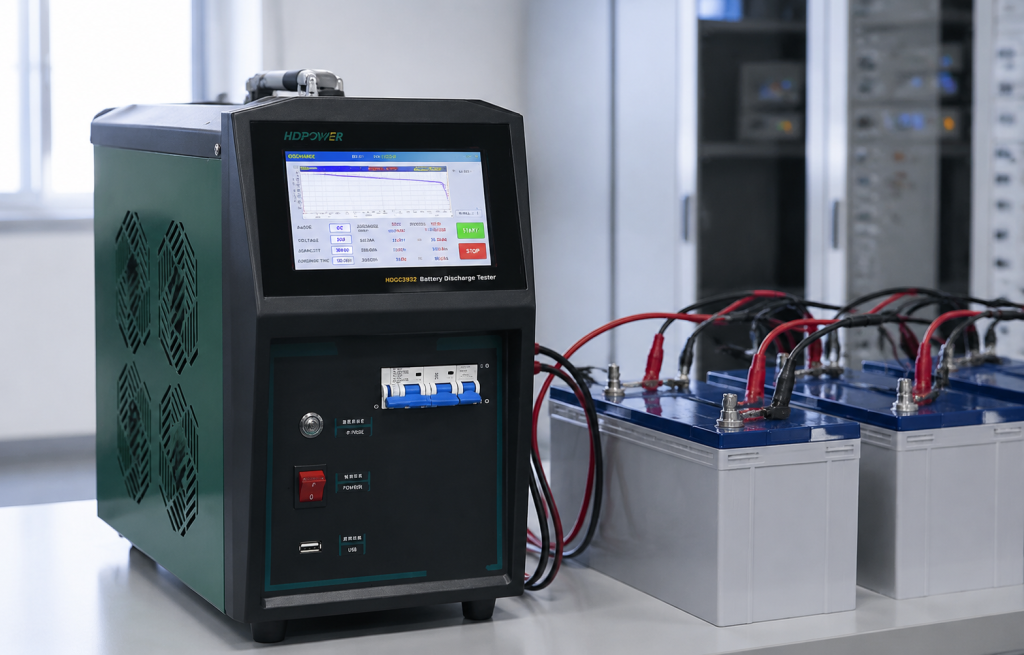
Controlled discharge testing is a direct method of evaluating how much charge a battery delivers under defined conditions. A suitable electronic load or discharge tester draws a specified current or power while recording battery voltage, current, elapsed time, and other available parameters.
For a constant-current test, delivered capacity can be calculated as:
Delivered Capacity (Ah) = Discharge Current (A) × Discharge Time (h)
For example, if a battery delivers 50 A for 8 hours under the specified test conditions, the calculated delivered capacity is 400 Ah.
This example is illustrative only. Actual capacity must be determined using the manufacturer’s specified discharge rate, end voltage, temperature conditions, and applicable test procedure.
Controlled discharge testing is especially useful for acceptance testing, periodic performance verification, troubleshooting, and evaluating aging battery banks. It can reveal limitations that a normal voltage measurement may not identify.
However, discharge testing requires careful planning. The test must remain within the battery’s permitted operating limits, and critical loads must remain protected throughout the procedure. A discharge test should never be started without an appropriate operational plan.
3.2 Internal Resistance Testing
Internal resistance testing provides a faster way to screen batteries and identify units that may be deteriorating. Changes in internal resistance or conductance can be associated with battery aging, connection problems, or other abnormal conditions.
A portable internal resistance tester can measure individual cells or batteries without requiring a full capacity discharge. This makes it useful for routine inspections and large battery installations where technicians need to examine many units efficiently.
Nevertheless, internal resistance is an indicator of condition, not a direct measurement of delivered ampere-hour capacity. Results are affected by battery design, chemistry, temperature, state of charge, measurement method, and connection quality.
Therefore, an apparently acceptable resistance reading should not be treated as conclusive proof of available capacity. Where capacity confirmation is required, controlled discharge testing remains an important verification method.
3.3 Voltage and Cell-Level Monitoring
Battery voltage measurements help technicians identify unusual differences between cells or modules. During discharge, monitoring individual cell voltages can reveal weak units that may otherwise be hidden by the total string voltage.
Voltage data should be interpreted in context. A normal voltage at rest does not necessarily mean that the battery can sustain its rated load for the required duration.
For critical installations, combining voltage monitoring with discharge current, elapsed time, temperature where available, and historical measurements provides a more useful view of battery performance.
3.4 Capacity Trend Analysis
A single test provides a snapshot of performance. Repeated assessments help reveal whether capacity is stable, declining gradually, or deteriorating more rapidly than expected.
For meaningful comparisons, technicians should document the test method, discharge rate, temperature, initial charging condition, end voltage, and relevant equipment settings. Differences in test conditions can affect the results and make direct comparisons misleading.
Historical records are particularly valuable when deciding whether a battery bank requires closer monitoring, maintenance, or replacement.
-
How to Conduct a Practical Battery Bank Capacity Assessment
An effective assessment should follow a consistent process rather than relying on isolated readings.
Step 1: Review Battery Specifications
Collect the manufacturer’s rated capacity, nominal voltage, discharge characteristics, permitted end voltage, recommended charging conditions, and maintenance guidance. Confirm the battery chemistry and bank configuration before selecting a test procedure.
Step 2: Inspect the Battery Bank
Check the installation for visible damage, swelling, leakage, corrosion, loose connections, abnormal temperatures, and other warning signs. Verify that the test area is suitable for the battery type and that the required protective equipment and emergency procedures are available.
Any obvious safety issue should be addressed before electrical testing begins.
Step 3: Perform Preliminary Measurements
Measure battery or cell voltage and, where appropriate, internal resistance or conductance. Record abnormal readings and compare them with previous measurements.
These preliminary checks help technicians identify potential problems and establish whether additional investigation is necessary. They do not replace a controlled capacity test when actual delivered capacity must be verified.
Step 4: Select the Appropriate Discharge Procedure
Choose the discharge current or power, test duration, termination voltage, and monitoring arrangement according to the battery manufacturer’s specifications and the applicable procedure.
Confirm that the testing equipment supports the battery bank’s voltage and current range. For installations with multiple strings or individual cell monitoring requirements, verify that the selected configuration can collect the necessary data.
Step 5: Execute and Monitor the Test
Connect the equipment according to its operating instructions and verify polarity, connection integrity, and protection settings. During discharge, monitor the relevant electrical parameters and stop the test when a defined termination condition or abnormal safety condition is reached.
Never exceed the permitted limits of the battery or testing equipment.
Step 6: Analyze and Document the Results
Calculate delivered capacity where applicable and compare the results with the rated value under equivalent conditions. Review cell-level measurements, voltage trends, test interruptions, and any abnormal observations.
A useful report should identify the tested battery bank, date, environmental conditions, test settings, measured results, calculation method, and recommended follow-up actions.
Step 7: Restore the Battery System
After testing, follow the manufacturer’s charging and recovery procedures. Verify that the battery bank has returned to the required operating condition before releasing it for normal service.
-
Choosing Equipment for Battery Bank Capacity Assessment
Selecting suitable equipment is essential for producing useful and repeatable results. The choice should reflect the test objective rather than relying on a product name alone.
Battery Discharge Testers for Direct Capacity Verification
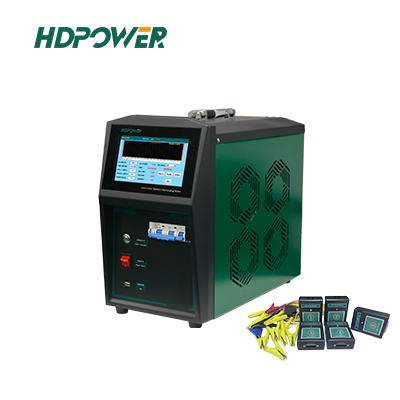
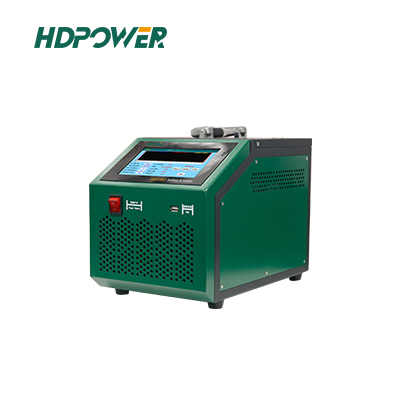
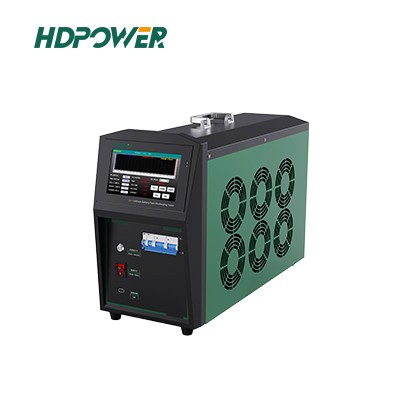
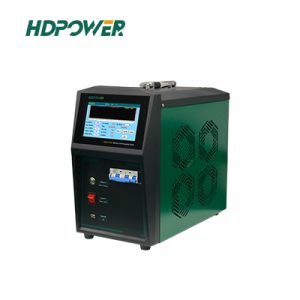
A battery discharge tester applies a controlled load and records the battery’s response during discharge. Depending on the model, functions may include constant-current or constant-power discharge, voltage monitoring, data logging, protection functions, and automatic report generation.
For lead-acid battery banks used in substations, UPS systems, telecommunications, and data centers, the tester should match the bank’s voltage, required discharge current, and monitoring needs.
Lithium battery applications require equipment compatible with the pack’s voltage range, chemistry, operating limits, and safety requirements. Test procedures should account for the battery management system and manufacturer-defined limits.
Explore HDPOWER’s Battery Discharge Load Tester solutions for industrial battery testing applications.
Internal Resistance Testers for Rapid Screening
Internal resistance testers are useful when maintenance teams need to inspect numerous cells or batteries efficiently. They can help identify abnormal units and prioritize follow-up inspections.
These instruments complement discharge testing by providing additional information about battery condition. They should not be used as a substitute for capacity verification when a direct measurement of delivered capacity is required.
See the Battery Internal Resistance Test Analyzer for rapid battery condition checks and maintenance applications.

Battery Activators for Suitable Lead-Acid Maintenance Tasks
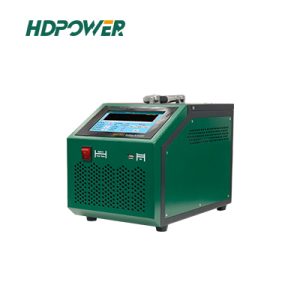
For compatible lead-acid batteries, an activator may support controlled charging, discharging, cycling, or maintenance procedures intended to address certain performance problems.
Its suitability depends on the battery’s condition, chemistry, construction, and the device’s supported operating modes. Activation is not a guaranteed remedy for permanent damage, severe degradation, or every cause of reduced capacity.
Maintenance procedures should follow the battery manufacturer’s recommendations and the equipment’s operating limits.
Data Recording and Reporting Functions
For larger installations, automated recording and reporting can make assessment more efficient. Stored data helps technicians compare measurements, trace abnormal results, and prepare maintenance documentation.
When evaluating equipment, consider parameter coverage, measurement accuracy, supported battery configurations, protection functions, report formats, and compatibility with the intended testing procedure.
-
Key Factors That Affect Capacity Assessment Results
Several factors can influence measured capacity and should be considered when interpreting results.
Temperature: Battery performance varies with temperature. Record the actual conditions and apply temperature corrections only when supported by the applicable procedure.
Discharge rate: A battery’s deliverable capacity can change with discharge current or power. Comparisons should use equivalent or appropriately adjusted test conditions.
Initial state of charge: An incompletely charged battery may produce a misleadingly low result. Follow the required charging and rest procedures before testing.
Termination voltage: Ending a test at a different voltage changes the amount of charge delivered. Use the specified endpoint for the selected battery and discharge rate.
Connection quality: Loose or corroded connections can affect measurements and introduce additional voltage drop. Inspect connections before and during testing as appropriate.
Battery chemistry and design: Lead-acid and lithium batteries have different operating characteristics, charging requirements, and safety limits. Use chemistry-appropriate procedures and equipment.
These factors should be recorded alongside test results to make conclusions more reliable and comparisons more meaningful.
-
Common Mistakes to Avoid
One common mistake is estimating capacity from open-circuit voltage alone. Voltage can provide useful information, but it cannot independently establish how long a battery will support a specified load.
Another mistake is treating internal resistance and capacity as interchangeable measurements. They describe different aspects of battery performance and should be interpreted accordingly.
Technicians should also avoid comparing results obtained under substantially different discharge rates, temperatures, charging conditions, or termination voltages without a suitable adjustment method.
Finally, testing should not compromise backup power availability. Before beginning, establish how critical loads will be supported, define stopping criteria, confirm equipment protections, and prepare a recovery plan.
A disciplined procedure improves measurement quality while helping protect personnel, batteries, and connected equipment.
-
Applications Across Critical Industries
Battery bank capacity assessment supports a range of industrial maintenance requirements.
Electric power substations: Verify DC backup battery performance and investigate weak cells that could affect protection and control systems.
UPS and data centers: Evaluate battery banks against backup runtime requirements and support planned maintenance.
Telecommunications: Assess batteries serving communication base stations and remote network facilities.
Rail transit: Support maintenance of backup power systems used by essential electrical and control infrastructure.
Industrial facilities: Monitor battery condition and plan maintenance for critical standby power installations.
Energy storage systems: Evaluate battery performance using procedures appropriate to the system architecture and battery chemistry.
In each application, the assessment plan should reflect the consequences of power failure, the battery manufacturer’s requirements, and the site’s operating constraints.
-
Turning Assessment Results into Maintenance Decisions
Test results are most valuable when they lead to clear, documented actions.
A battery bank that performs as expected may remain on its established maintenance schedule. A bank showing an unusual decline may require a repeat test, closer monitoring, cell-level investigation, or review of its charging system and operating environment.
Where individual cells show abnormal results, technicians should determine whether the cause is related to connections, charging conditions, temperature, or battery degradation before selecting a corrective action.
Replacement decisions should consider applicable maintenance criteria, the manufacturer’s recommendations, historical trends, and the reliability requirements of the installation. A single measurement should not automatically determine the replacement of an entire battery bank.
Standardized reports make it easier for different maintenance teams to compare findings and establish a consistent record of battery condition over time.
Conclusion
Battery bank capacity assessment is an important tool for maintaining reliable backup power and making informed battery maintenance decisions. By combining controlled discharge testing, internal resistance screening, cell-level monitoring, and historical trend analysis, maintenance teams can develop a more complete understanding of battery performance.
The right testing equipment depends on the battery chemistry, voltage and current requirements, measurement objectives, and operational constraints. Accurate test conditions, appropriate safety precautions, and consistent reporting are equally important.
HDPOWER provides battery testing and maintenance equipment for industrial applications involving lead-acid and lithium batteries. By selecting suitable instruments and following a structured assessment procedure, organizations can improve maintenance efficiency, identify potential problems earlier, and make better-informed decisions about battery service life and replacement.