Introduction
Reliable backup power depends on more than a battery’s rated voltage. A battery system may show normal voltage during routine inspection while its available capacity has already declined because of aging, sulfation, corrosion, repeated cycling, temperature exposure, or prolonged standby operation. For critical infrastructure, controlled discharge testing provides a practical way to verify whether a battery system can still deliver the required energy under defined operating conditions.
Industrial Battery Discharge Equipment is designed for this purpose. Unlike a simple voltage checker, professional discharge equipment applies a controlled electrical load and records key parameters throughout the test. Engineers can use the resulting data to evaluate battery performance, identify abnormal behavior, compare test results over time, and support maintenance or replacement decisions.
For UPS systems, telecommunications sites, substations, data centers, power plants, and rail transit infrastructure, industrial discharge testing can become an important part of battery maintenance and reliability management.
Why Industrial Battery Discharge Testing Matters
A battery’s open-circuit or float voltage provides only a limited view of its condition. A weak battery can sometimes maintain an apparently normal voltage until a significant load is applied. Once the battery is required to supply current, voltage may fall rapidly or the available capacity may prove insufficient.
Controlled discharge testing addresses this limitation by placing the battery or battery bank under a defined electrical load. The test can then reveal how the system behaves as energy is delivered.
Depending on the test objective, engineers may evaluate:
- Battery voltage during discharge
- Discharge current
- Discharge time
- Delivered capacity
- Voltage variation between cells or units
- Discharge curves
- Cutoff behavior
- Abnormal temperature or protection conditions
This makes discharge testing useful for both scheduled maintenance and troubleshooting. Instead of relying only on a snapshot measurement, maintenance teams obtain a recorded performance profile that can be compared with previous tests.
For industrial battery maintenance, the objective is not simply to discharge a battery. The objective is to obtain measurable evidence about whether the battery system can continue to perform its intended backup function.
How Industrial Battery Discharge Equipment Works
Professional discharge equipment generally operates by connecting the battery system to a controlled load and configuring the required test parameters.
A typical workflow includes five stages.
- Define the Test Conditions
Before starting, the technician determines the battery system voltage, target discharge current or power, cutoff voltage, test duration, and other applicable limits. The settings should match the battery manufacturer’s specifications and the maintenance procedure used by the facility.
The test objective should also be defined in advance. A capacity verification test may require different settings from a troubleshooting test intended to identify an abnormal battery or cell.
- Connect the Battery System
The equipment is connected to the battery bank with suitable cables and protection arrangements. Correct polarity and secure connections are essential before the discharge begins.
For systems requiring cell-level monitoring, additional measurement modules can be installed to track individual battery or cell voltage during the test. This can provide more detailed information than monitoring the total battery-bank voltage alone.
- Apply a Controlled Load
The tester begins discharging according to the selected operating mode. Constant-current discharge is commonly used when a stable current is required throughout the test. Constant-power discharge can be useful when the test objective is related to a specified power demand.
The appropriate mode depends on the battery system, test procedure, and engineering objective.
- Monitor the Discharge Process
Voltage, current, elapsed time, and calculated capacity can be monitored during operation. If cell-level monitoring is available, engineers can observe individual voltage behavior and identify abnormal units within the battery bank.
Real-time monitoring is particularly useful for large battery systems because the overall bank voltage may not immediately reveal an individual weak battery.
- Stop and Analyze the Test
The test ends when the preset cutoff condition, time limit, or other protection condition is reached. The recorded data can then be reviewed and exported for maintenance records, comparison, or reporting.
A documented test history allows engineers to compare results over multiple maintenance cycles instead of evaluating battery condition from a single measurement.
Key Features to Consider When Selecting Equipment
Not every battery discharge application requires the same equipment. When selecting an industrial solution, engineers should evaluate the following technical factors.
Voltage Range
The equipment should match the DC voltage of the battery system. Common industrial applications include low-voltage battery banks as well as 110 V and 220 V DC systems. The required operating range should be checked before purchasing to ensure the tester can operate safely across the intended battery configuration.
Discharge Current and Power
Discharge current determines how much load the equipment can apply. High-capacity battery banks may require substantially higher current than individual batteries or small UPS systems.
Some systems also support constant-power discharge, which provides another way to simulate defined operating conditions. The required current and power range should therefore be considered together with the battery-bank voltage.
Monitoring Accuracy
Accurate voltage and current measurement is essential because the final capacity calculation depends on the recorded electrical parameters.
For battery-bank maintenance, individual cell voltage monitoring can provide additional diagnostic information beyond overall bank voltage. It can help maintenance personnel identify units whose voltage behavior differs significantly from the rest of the system.
Data Logging and Reporting
A professional test should produce more than a simple pass/fail result. Recorded voltage, current, time, capacity, and curve data can help engineers understand battery behavior and maintain historical records.
Exportable reports are especially useful for periodic inspections, maintenance contractors, and facilities with formal asset-management procedures.
Safety Protection
Discharging a large battery bank involves significant electrical energy. Industrial equipment should therefore include appropriate protection and alarm functions.
Depending on the model and application, useful functions may include overcurrent protection, overtemperature protection, reverse-polarity detection, abnormal-condition alarms, and emergency shutdown interfaces.
Portability and Field Operation
Many industrial battery tests take place in existing substations, telecom rooms, UPS rooms, or other facilities rather than laboratories.
Portable or mobile equipment can reduce installation requirements and make scheduled field testing more practical. This is particularly useful for maintenance teams that need to move between multiple battery rooms or sites.
Applications of Industrial Battery Discharge Equipment
UPS Battery Testing
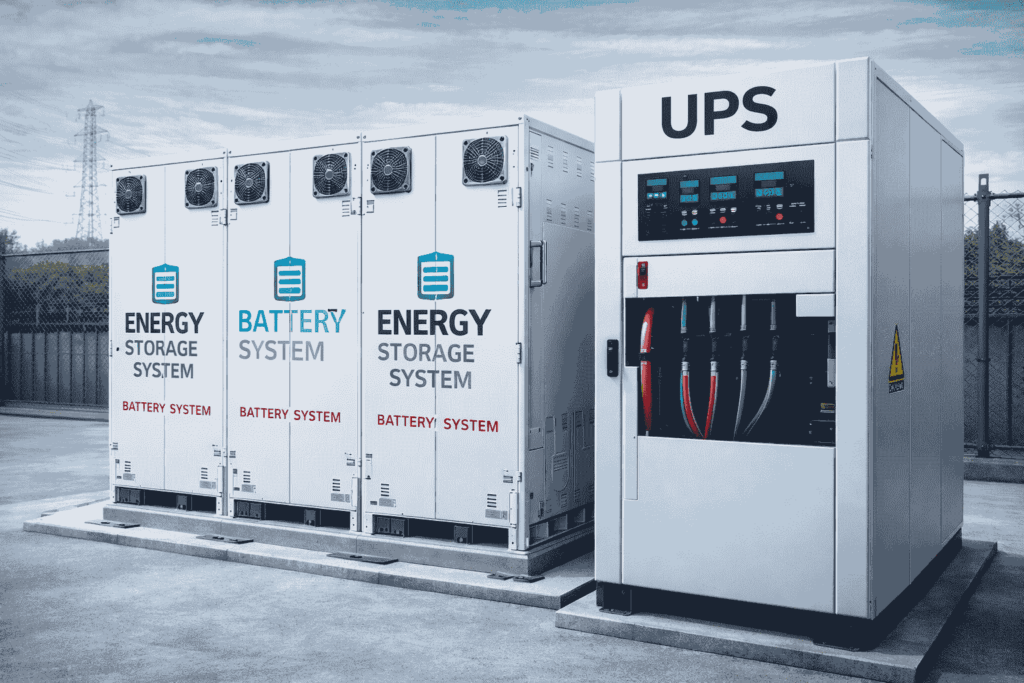
UPS systems depend on batteries to provide backup power when utility power fails. A scheduled discharge test can help verify whether the battery bank can provide the expected backup performance.
This is particularly important in data centers, industrial control rooms, financial facilities, and other environments where an unexpected power interruption can have significant operational consequences.
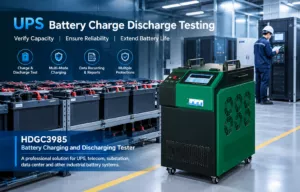
For more information about battery testing in these applications, see UPS Battery Charge Discharge Testing.
Telecommunication Backup Batteries
Telecom base stations often rely on lead-acid battery banks for backup power. Over time, aging or degraded batteries can reduce the reliability of the backup system.
Controlled discharge testing can help maintenance teams identify underperforming battery banks and support replacement planning. Combining discharge testing with individual battery voltage monitoring can provide additional information when troubleshooting a battery bank.
Substation and DC Power Systems
Substations use DC battery systems for critical control, protection, and switching functions. A discharge test provides a way to evaluate the available capacity of the battery system under controlled conditions.
When combined with cell-level monitoring, the test can also help locate individual batteries that behave differently from the rest of the bank.
Data Center Battery Maintenance
Data centers require predictable backup power performance. Battery discharge testing can be incorporated into a broader maintenance program to verify battery-bank performance and establish historical test records.
The test results can support decisions about maintenance intervals, battery replacement, and system reliability.
Rail Transit and Industrial Facilities
Rail transit systems, power plants, and other industrial facilities may use stationary batteries for backup and control applications.
Because these systems can involve different voltage levels and battery-bank configurations, the discharge equipment should be selected according to the actual system parameters and the applicable test procedure.
Battery Maintenance vs. Simple Voltage Inspection
Voltage inspection remains useful as a quick diagnostic step, but it should not be treated as a complete capacity evaluation.
A battery can have an acceptable resting or float voltage while its usable capacity has deteriorated. Discharge testing provides a different type of information: how the battery performs while delivering energy.
For example, a maintenance program may combine:
- Routine voltage inspection
- Internal resistance measurement
- Visual inspection
- Cell-level monitoring
- Controlled discharge testing
- Historical data comparison
Each method answers a different question. Discharge testing is particularly valuable when the objective is to verify usable capacity and performance under a controlled load.
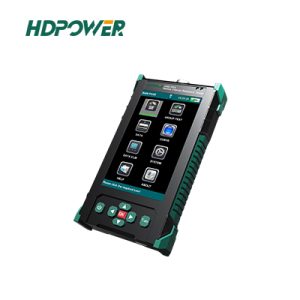
For fast electrical condition checks, engineers can also use Battery IR Tester as part of a broader battery maintenance workflow.
How to Choose the Right Industrial Battery Discharge Equipment
The appropriate solution depends on the battery system and the purpose of the test. Before selecting equipment, define the following requirements:
- Battery chemistry: Determine whether the application involves lead-acid, lithium-ion, or another chemistry.
- System voltage: Determine the actual operating range rather than relying only on nominal voltage.
- Required discharge current or power: Select equipment that provides sufficient capacity for the intended test.
- Test method: Determine whether constant-current, constant-power, or another defined procedure is required.
- Cell monitoring: Decide whether individual cell voltage monitoring is necessary.
- Test duration and cutoff: Define the required test time and termination conditions.
- Data reporting: Consider whether test data must be exported for maintenance records.
- Site conditions: Evaluate portability, available power, workspace, ventilation, and operating environment.
- Safety requirements: Check protection functions and emergency shutdown requirements.
- Future expansion: For large battery banks, consider whether multiple testers may need to operate in parallel.
For stationary lead-acid backup systems, equipment should be matched to the battery-bank voltage and expected discharge requirements. For specialized applications, engineers may also need wireless cell monitoring, programmable test procedures, or parallel operation.
HDPOWER Industrial Battery Discharge Solutions
HDPOWER provides battery testing equipment for industrial battery maintenance, including UPS battery banks, telecommunications backup batteries, substation DC systems, data centers, power utilities, and rail transit applications.
The company’s discharge testing range includes equipment designed to monitor voltage, discharge current, discharge time, and calculated capacity during controlled testing.
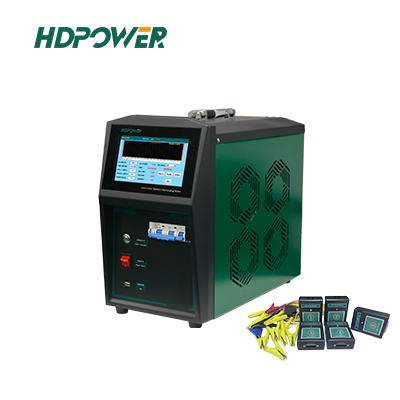
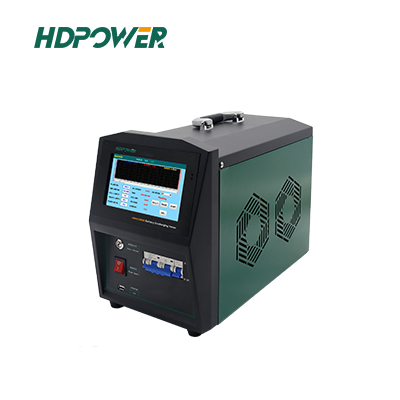
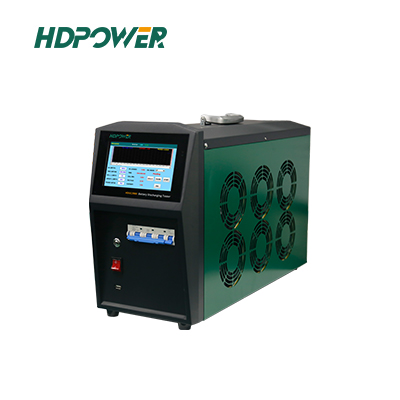
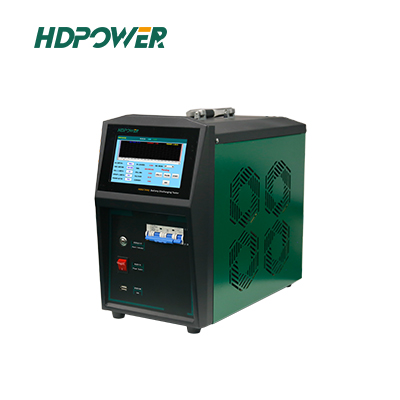
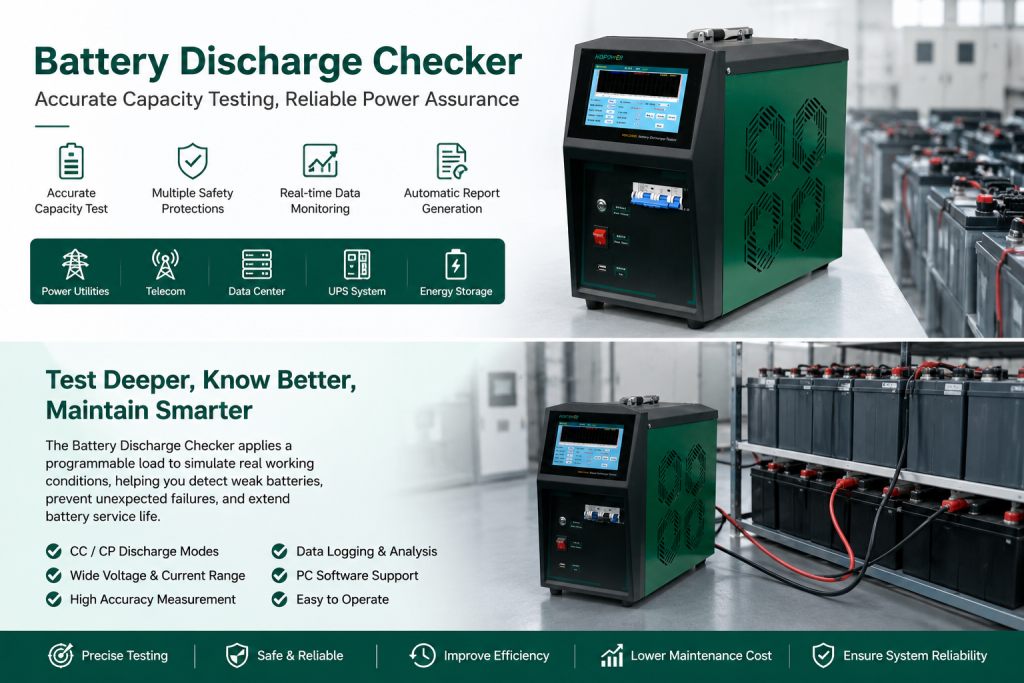
The HDGC3980 series is designed for battery discharge experiments, capacity testing, and daily maintenance. Depending on the configuration, the equipment supports different voltage and current ranges and can be equipped with cell-voltage monitoring functions.
The HDGC3982 adds battery-bank discharge monitoring capabilities, allowing engineers to evaluate discharge performance while monitoring individual cell voltage. Multiple testers can also be operated in parallel for applications requiring higher discharge current.
For facilities that need both charging and discharging functions, HDPOWER also provides integrated charging and discharging equipment. This can be useful when battery maintenance requires controlled charging, activation, capacity verification, and discharge testing within one workflow.
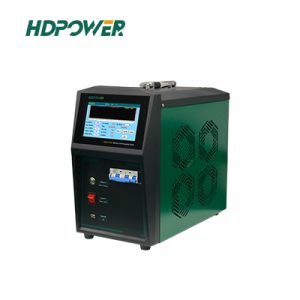
For the dedicated product solution, visit Battery Discharging Tester.
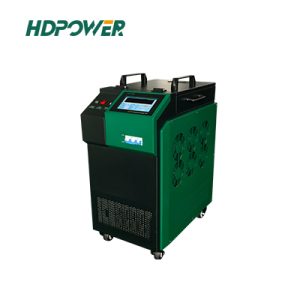
For applications requiring both charging and discharging functions, see Battery Charge And Discharge Tester.
Best Practices for Industrial Battery Discharge Testing
A controlled discharge test should always follow the battery manufacturer’s specifications and the facility’s safety procedures.
Before testing, verify the battery configuration, cable connections, polarity, ventilation, temperature conditions, and emergency procedures.
During the test, technicians should monitor the battery system and the tester’s alarms rather than leaving the equipment unattended unless the equipment and site procedure specifically support unattended operation.
After the test, save the recorded data and compare it with previous results where available. Trends can be more useful than a single test result because gradual changes in capacity or cell voltage behavior may indicate developing battery problems.
For organizations responsible for multiple battery systems, maintaining standardized test records can also make it easier to compare battery performance between inspection periods and identify batteries that require additional investigation.
Conclusion
Industrial Battery Discharge Equipment provides a controlled and measurable way to evaluate the performance of battery systems used in critical infrastructure.
By applying a defined load and recording voltage, current, time, capacity, and other parameters, engineers can obtain information that routine voltage inspection alone cannot provide.
For UPS systems, telecom backup power, substations, data centers, rail transit, and industrial facilities, discharge testing can form an important part of a structured battery maintenance program.
The right equipment should be selected according to battery chemistry, system voltage, discharge requirements, monitoring needs, safety conditions, portability, and reporting requirements.
When battery reliability directly affects system availability, a documented discharge test turns battery maintenance from a simple inspection into a measurable engineering process.