Introduction
Lead-acid batteries remain an important power source for UPS systems, telecommunications infrastructure, substations, data centers, industrial equipment, and other backup power applications. Although these batteries are designed for reliable long-term operation, their usable capacity can gradually decline because of sulfation, undercharging, deep discharge, long-term storage, and inadequate maintenance.
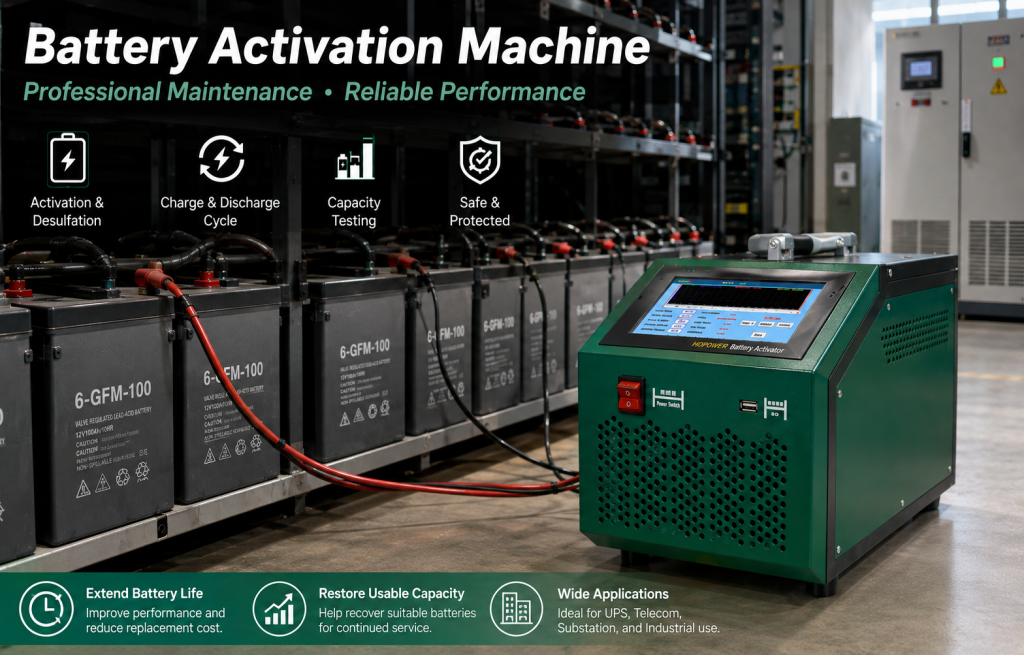
When battery performance starts to deteriorate, replacing an entire battery bank is not always the only option. For suitable batteries, a Battery Life Extender Machine can be used as part of a professional maintenance process to evaluate battery condition, perform controlled charging and discharging, activate the battery, and verify whether usable performance has improved.
Unlike a conventional charger, which is primarily designed to replenish electrical energy, a battery life extension machine focuses on battery maintenance and performance recovery. For lead-acid battery systems affected by recoverable degradation, controlled activation and charge-discharge cycling can help restore battery activity and potentially delay premature replacement.
What Is a Battery Life Extender Machine?
A Battery Life Extender Machine is professional equipment designed to support the maintenance and performance recovery of aging batteries. In lead-acid battery applications, the equipment may combine controlled discharge, intelligent charging, activation, and repeated charge-discharge cycling in one maintenance workflow.
The term “battery life extender” describes the intended result: helping suitable batteries maintain or recover usable performance for a longer service period. In practical industrial applications, this type of equipment is often closely associated with a Battery Activator, battery recovery machine, or battery reconditioning equipment.
The important distinction is that battery life extension should not be viewed as simply charging an old battery again. A battery may reach its normal charging voltage while still having insufficient capacity under load. A professional maintenance process therefore needs to evaluate the battery before activation and verify its condition afterward.
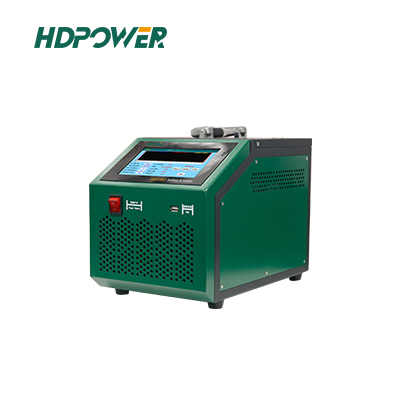
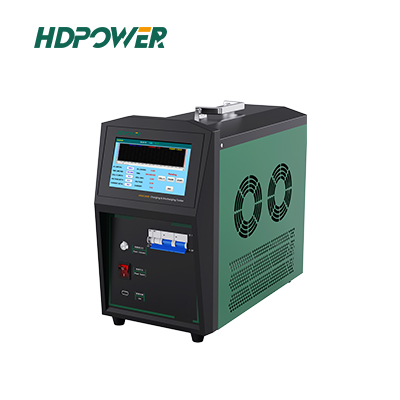
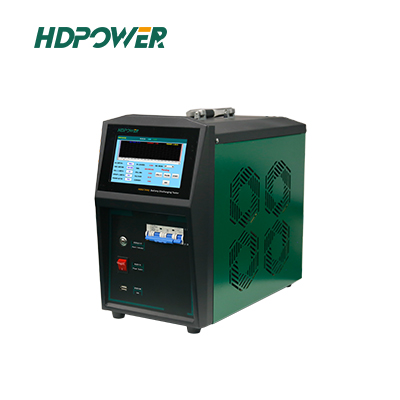
HDPOWER’s HDGC3932 Battery Activator, for example, combines activation, constant-current discharge, intelligent charging, and cyclic charge-discharge functions for 2V, 6V, and 12V lead-acid batteries. Its operating concept is designed around controlled electrical maintenance rather than simple energy replenishment.
Why Do Lead-Acid Batteries Lose Their Service Life?
Several factors can contribute to declining lead-acid battery performance.
- Sulfation
Sulfation is one of the most common causes of performance degradation in lead-acid batteries. During normal discharge, lead sulfate forms on the battery plates and is normally converted back during charging. However, prolonged undercharging, partial-state-of-charge operation, or long periods of inactivity can encourage harder sulfate crystals to form.
As these crystals accumulate, the effective active surface area of the plates can decrease. The result may include reduced charge acceptance, higher internal resistance, lower discharge performance, and declining usable capacity.
This is one reason why battery sulfation recovery is an important part of professional lead-acid battery maintenance.
- Long-Term Storage
A battery that remains unused for an extended period can gradually lose its state of charge. If appropriate maintenance charging is not provided, degradation can accelerate.
This is particularly relevant to standby batteries because they may remain idle for long periods and only be required to deliver significant current during a power outage.
- Undercharging and Improper Charging
Repeated undercharging can leave lead-acid batteries in an unfavorable operating condition. Incorrect charging parameters can also affect battery performance and service life.
A professional activation system can provide more controlled charging and cycling than a basic charger, allowing technicians to observe how the battery responds during the process.
- Repeated Deep Discharge
Deep discharge is sometimes unavoidable in backup power applications, but repeated or poorly controlled deep discharge can accelerate battery degradation.
For this reason, battery maintenance should combine appropriate testing, charging, discharge control, and performance verification rather than relying on a single maintenance method.
How Does a Battery Life Extender Machine Work?
A professional battery life extension process generally follows several stages.
Step 1: Test the Battery Condition
Before attempting recovery, technicians should determine whether the battery is a suitable candidate for activation.
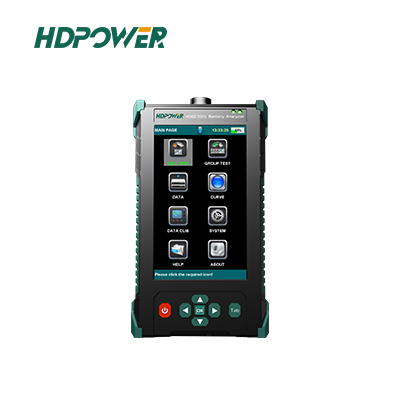
Useful information may include terminal voltage, internal resistance, discharge behavior, available capacity, and charging response. A Battery Capacity Tester can be used to evaluate usable capacity under controlled discharge conditions.
This initial measurement establishes a baseline. Without a pre-maintenance test, it is difficult to determine whether the battery actually improved after activation.
Step 2: Controlled Discharge
Controlled discharge helps reveal how the battery performs under load.
Instead of judging battery condition solely from its open-circuit voltage, technicians can observe voltage behavior, current, discharge duration, and calculated capacity.
A Battery Discharge Tester can therefore complement a battery life extension machine when a more complete maintenance workflow is required.
Step 3: Intelligent Charging
After discharge, the battery can be charged under controlled conditions.
Depending on the equipment and battery requirements, charging parameters can be adjusted to provide an appropriate charging process. Intelligent charging is particularly useful because the objective is not simply to force current into the battery, but to manage the battery’s response throughout the maintenance cycle.
Step 4: Battery Activation and Cycling
This is the central stage of the battery life extension process.
Professional activation equipment can combine controlled electrical stimulation with repeated charging and discharging. The purpose is to encourage the reactivation of usable battery materials and reduce the effects of recoverable sulfation.
HDGC3932 uses high-frequency, low-voltage, and high-current characteristics with directional current to target lead sulfate crystals on the battery plates. It also supports constant-current discharge, intelligent charging, and cyclic charge-discharge operation.
Repeated cycling can be especially useful when a battery has suffered from prolonged inactivity or insufficient cycling. However, the actual recovery result depends on the battery’s chemistry, age, physical condition, and degradation mechanism.
Step 5: Retest and Verify
A battery should not be considered recovered simply because its voltage looks normal after charging.
The most meaningful verification is to compare measurable performance before and after maintenance. Capacity, discharge behavior, voltage response, and other relevant parameters can be compared to determine whether the battery has achieved a meaningful improvement.
This creates a practical maintenance cycle:
Test → Diagnose → Activate → Charge/Discharge Cycle → Retest → Evaluate
This approach makes battery life extension measurable rather than based on assumptions.
Battery Life Extender Machine vs. Conventional Battery Charger
A conventional battery charger and a Battery Life Extender Machine serve different purposes.
A standard charger primarily replenishes electrical energy and maintains the battery at an appropriate state of charge.
A battery life extension machine is designed for a broader maintenance workflow that may include:
- Controlled discharge
- Intelligent charging
- Battery activation
- Charge-discharge cycling
- Capacity verification
- Data recording and analysis
For example, HDGC3932 supports constant-current discharge, intelligent charging, activation, and multiple protection functions. Its software can also display voltage and current curves and generate test reports for maintenance records.
Therefore, the two types of equipment should not be treated as direct substitutes. A charger helps maintain normal battery operation, while activation equipment is intended for more advanced maintenance and performance recovery.
When Should You Use a Battery Life Extender Machine?
Battery life extension is most appropriate when testing indicates that the battery has potentially recoverable performance degradation.
Typical situations include:
- Lead-acid batteries with reduced usable capacity
- Batteries affected by sulfation
- Batteries that have remained undercharged
- Batteries subjected to prolonged storage
- Standby batteries showing declining discharge performance
- Battery banks approaching replacement because of capacity deterioration
- Maintenance programs seeking to reduce premature battery replacement
For industrial users, the economic benefit can be significant. Replacing an entire battery bank may involve equipment costs, labor, transportation, disposal, installation, and system downtime. If suitable batteries can be restored and returned to service, the replacement cycle may potentially be delayed.
However, battery activation is not a universal solution.
Batteries with severe physical damage, leakage, shorted cells, severe corrosion, or irreversible degradation may not be suitable for recovery. In critical applications, replacement may remain the safer and more appropriate decision. The correct approach is to test first and make the maintenance decision based on measured battery condition.
Applications of Battery Life Extension Equipment
Battery Life Extender Machines are particularly useful where large numbers of lead-acid batteries must be maintained systematically.
UPS Battery Maintenance
UPS systems require reliable backup batteries to provide emergency power during utility failures. Regular testing and activation can help maintenance teams identify weak batteries and evaluate whether suitable batteries can continue operating.
Telecom Base Stations
Telecommunication sites often depend on lead-acid backup batteries. Professional activation and testing equipment can support scheduled maintenance while helping reduce unnecessary battery replacement.
Substations and Power Utilities
Station batteries are critical for protection, control, and DC power systems. A structured maintenance process combining testing, activation, and capacity verification can provide better information for maintenance decisions.
Data Centers
Data centers require high battery reliability because backup power performance directly affects business continuity. Battery life extension equipment can be incorporated into preventive maintenance programs alongside testing equipment.
Battery Maintenance Service Providers
Professional battery maintenance companies can use activation equipment to provide testing, restoration, and verification services for industrial customers.
How to Choose a Battery Life Extender Machine
When selecting equipment, consider more than the advertised “battery life extension” function.
First, check the supported battery voltage. For example, HDGC3932 is designed for 2V, 6V, and 12V lead-acid batteries.
Second, check the available charging and discharge current. Different battery capacities require different operating ranges.
Third, consider whether the equipment supports both charging and discharging. An integrated system can simplify the maintenance workflow by reducing the need to move batteries between different devices.
Fourth, look for data recording and reporting capabilities. Test curves, capacity results, voltage and current records, and exported reports can be valuable for maintenance documentation.
Finally, consider protection functions. Over-current, over-temperature, reverse-polarity, and abnormal-condition protection are important when working with high-current battery maintenance equipment.
Extend Battery Life Through a Complete Maintenance Strategy
A Battery Life Extender Machine should not be viewed as a standalone “repair box.” The most effective approach is to integrate activation into a complete battery maintenance strategy.
A practical workflow is:
Routine Inspection → Battery Testing → Capacity Evaluation → Activation → Controlled Cycling → Retesting → Maintenance Decision
For deeper diagnostics, technicians can combine a battery activator with a Battery IR Tester to identify abnormal cells or increased internal resistance.
This combination helps distinguish batteries that may benefit from activation from batteries that are approaching irreversible failure.
The same principle applies to large battery banks. Maintenance teams can use testing results to identify weak batteries, perform appropriate maintenance, and document the final condition before deciding whether to reuse or replace the battery.
Extend Battery Service Life with HDPOWER Battery Activation Equipment
For lead-acid battery maintenance, HDPOWER’s HDGC3932 Battery Activator provides an integrated solution for activation, charging, discharging, and cycling.
The unit supports 2V, 6V, and 12V lead-acid batteries, with discharge and charging current ranges designed for different battery voltage levels. It also provides data storage, curve display, protection functions, preset test parameters, and report generation.
For maintenance teams looking for a battery life extension machine, the key advantage of an integrated battery activator is that it connects battery testing and restoration into a repeatable workflow.
Instead of replacing a battery simply because its performance has declined, technicians can first determine the actual condition, perform activation when appropriate, and then verify the result through controlled testing.
Conclusion
A Battery Life Extender Machine provides a professional approach to maintaining suitable aging lead-acid batteries. By combining controlled discharge, intelligent charging, activation, and charge-discharge cycling, it can help address performance degradation associated with conditions such as sulfation and insufficient cycling.
The most important principle is that battery life extension should be based on measurement rather than assumption. Testing before activation establishes a performance baseline, while testing afterward determines whether meaningful recovery has been achieved.
For UPS systems, telecommunications infrastructure, substations, data centers, and other industrial applications, integrating a Lead Acid Battery Activator into a structured maintenance program can help improve battery utilization, support maintenance decisions, and potentially delay unnecessary replacement.
For organizations seeking to reduce battery lifecycle costs while maintaining reliable backup power, professional battery activation and testing equipment can be a valuable part of a modern lead-acid battery maintenance strategy.