Introduction
Battery systems used in UPS rooms, telecommunications facilities, substations, data centers, rail transit systems, and industrial backup power installations must remain dependable even when the main power supply is unavailable. Regular testing is therefore essential for identifying abnormal batteries before they affect the reliability of the entire battery bank.
Among the different methods used for battery maintenance, resistance measurement provides a fast way to compare individual batteries and identify units whose electrical characteristics differ significantly from the rest of the bank. Professional Battery Resistance Testing Equipment can measure low resistance values in the milliohm range while also recording battery voltage and test data for maintenance analysis.
Unlike a simple voltage check, resistance testing provides an additional electrical parameter that can help maintenance engineers identify developing battery problems. When combined with capacity testing, visual inspection, charging data, and historical measurements, resistance testing becomes a practical part of a preventive battery maintenance program.
What Is Battery Resistance Testing Equipment?
Battery Resistance Testing Equipment is designed to measure the electrical resistance characteristics of individual batteries or battery groups. Depending on the equipment design and measurement method, the instrument can measure resistance, terminal voltage, conductance, or related electrical parameters.
Battery resistance is typically measured in milliohms (mΩ), because the resistance of a healthy battery is normally very low. Small changes can therefore be meaningful when batteries of the same type, age, and operating conditions are compared.
For industrial battery maintenance, the objective is not simply to obtain one resistance value. The more useful approach is to establish a baseline, compare batteries within the same bank, and monitor changes over time.
For example, if most batteries in a battery bank show similar resistance values while one battery has a significantly different result, that battery may require additional inspection. The result does not automatically prove that the battery has failed, but it provides maintenance personnel with a useful indication that further investigation may be appropriate.
Why Is Battery Resistance Measurement Important?
Battery degradation is not always obvious from terminal voltage alone. A battery can display an apparently normal voltage while its internal electrical characteristics are changing.
Resistance measurement adds another layer of information to routine battery inspection.
As batteries age, their electrochemical and physical characteristics can change. These changes may influence resistance, voltage response, and the battery’s ability to deliver current under load. Measuring resistance periodically allows maintenance teams to establish historical data and identify abnormal trends.
Three aspects are particularly useful.
- Identifying Abnormal Batteries
In a series-connected battery bank, individual batteries do not necessarily age at the same rate. Differences in temperature, charging conditions, manufacturing variation, operating history, and installation environment can cause one battery to deteriorate faster than others.
Resistance testing allows technicians to compare individual units rather than evaluating the entire battery bank as a single system.
- Supporting Preventive Maintenance
Routine resistance measurements can be incorporated into scheduled inspections for UPS systems, telecom battery banks, substations, and other backup power installations.
Instead of waiting for a battery to show an obvious failure symptom, maintenance teams can track measurements and investigate unusual changes earlier.
- Improving Maintenance Records
Modern battery maintenance requires more than a technician’s handwritten notes. Test data should ideally be stored and compared with previous inspection results.
Battery Resistance Testing Equipment with data storage and export functions can help maintenance teams build a historical record for individual batteries and battery banks.
This is particularly useful for large sites where hundreds of batteries may need to be inspected periodically.
Battery Resistance Testing vs. Battery Capacity Testing
Resistance measurement and capacity testing provide different types of information and should not be treated as interchangeable methods.
A resistance test is generally a rapid diagnostic measurement. It can be performed on individual batteries and is useful for comparing batteries, screening abnormal units, and monitoring trends.
A capacity test, on the other hand, evaluates how much energy a battery can actually deliver under a defined discharge condition. A controlled discharge test normally takes considerably longer and requires specific current, end-voltage, and duration settings.
For industrial maintenance, these two methods can complement each other.
A practical testing workflow may begin with rapid resistance and voltage measurements. Batteries showing abnormal results can then be selected for additional capacity testing or other diagnostic procedures.
This layered approach can help maintenance teams use their testing resources more efficiently while obtaining more complete information about battery performance.
Where Is Battery Resistance Testing Equipment Used?
UPS Battery Maintenance
UPS systems rely on battery banks to provide backup power when utility power is interrupted. A weak battery can affect the performance of the complete string.
Regular resistance measurement allows technicians to compare individual batteries within a UPS battery bank and identify units that require closer inspection.
For large UPS rooms, portable equipment can also reduce the time required for routine inspections.
Telecom Base Stations
Telecommunication facilities often use lead-acid battery banks as backup power sources. These batteries may be installed in distributed locations, making portability an important consideration for maintenance personnel.
A handheld resistance measurement device can allow technicians to perform field measurements without transporting large test systems to every site.
Substations and Power Systems
DC battery systems in substations support protection, control, switching, and emergency functions. Maintaining the battery bank is therefore an important part of overall system reliability.
Resistance testing can be incorporated into periodic inspections to compare individual cells or batteries and identify abnormal measurement results.
When the battery system remains connected to the DC bus, online measurement capability can also be valuable because it can reduce the need for unnecessary disconnection during routine inspection.
Data Centers
Data centers require highly reliable backup power infrastructure. Battery degradation may develop gradually and may not be obvious during normal operation.
Routine electrical measurements, historical data comparison, and periodic capacity verification can provide maintenance engineers with a more structured way to monitor battery systems.
Battery Manufacturing and Quality Inspection
Resistance measurement is also useful during battery production and incoming inspection.
Manufacturers can compare resistance values between batteries or batches, identify abnormal units, and establish measurement records for quality control.
The appropriate measurement method and acceptance criteria should always be determined according to the battery manufacturer’s specifications and the intended application.
What Should You Look for in Battery Resistance Testing Equipment?
Selecting suitable equipment depends on the battery type, voltage range, application environment, and required measurement accuracy.
Low-Resistance Measurement Resolution
Because battery resistance is normally very small, the equipment should provide appropriate resolution for the intended battery type.
For industrial batteries, milliohm-level measurement capability can be important when comparing individual batteries within the same bank.
However, resolution should not be considered separately from overall measurement stability and accuracy. A display with many decimal places does not automatically mean that the measurement is more reliable.
Suitable Voltage Range
The instrument should support the nominal voltage of the batteries being tested.
A tester intended for individual low-voltage cells may not be suitable for every battery system. Before purchasing equipment, maintenance teams should confirm the supported voltage range and the battery configurations that can be measured.
Online and Offline Testing
For large battery installations, disconnecting cables or busbars for every measurement can increase maintenance time and operational complexity.
Online measurement capability can therefore be valuable in industrial applications.
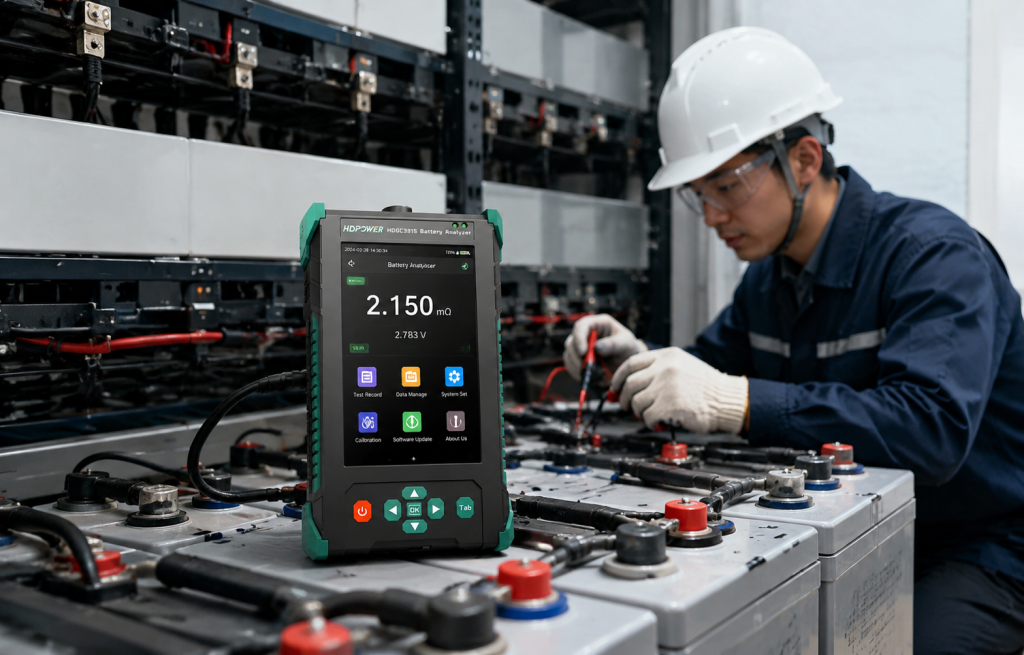
HDGC3915 Battery Testing Equipment supports both online and offline measurement and is designed to measure without disassembling or disconnecting the busbar. Its anti-interference design is intended for field environments where electrical noise may affect measurement stability.

Single Battery and Battery Group Testing
A practical instrument should support the measurement method required by the maintenance workflow.
Testing individual batteries makes it possible to compare units within a battery bank, while battery group measurement can help technicians evaluate the overall installation more efficiently.
HDGC3915 supports individual battery and battery group measurement, allowing the same instrument to be used for different inspection tasks.
Data Storage and Export
Data management becomes increasingly important as the number of batteries increases.
Equipment with internal storage and USB export allows technicians to save measurement records and transfer them to a computer for further analysis and reporting.
For maintenance departments, historical records can also make it easier to compare measurements from different inspection periods.
Portability
Battery maintenance frequently takes place in equipment rooms, substations, telecom sites, and other locations where large testing systems are inconvenient to move.
A lightweight handheld design can allow one technician to carry the equipment between battery cabinets and testing points.
HDGC3915 Battery Resistance Testing Equipment for Field Maintenance
The HDPOWER HDGC3915 is a handheld battery testing instrument designed for professional battery maintenance applications.
It uses an AC discharge test method to measure battery voltage and resistance characteristics. The instrument supports individual battery and battery group measurement and can be used for online or offline testing.
The HDGC3915 provides an internal resistance measurement range of 0.01 mΩ to 120 mΩ and a voltage measurement range of 1.000 V to 25 V. It also supports conductance measurement from 20 to 19,990 S.
Its main features include:
- Single-battery and battery-group measurement
- 0.01 mΩ–120 mΩ resistance measurement range
- 1.000–25 V voltage measurement range
- Online and offline measurement
- Measurement without disconnecting the busbar
- Strong anti-interference capability for field applications
- 5-inch color touchscreen
- Key operation for use with insulated gloves
- Built-in reference values for battery resistance
- Large data storage capacity
- USB data export
- Excel and Word report generation
- Portable handheld design
These features make the HDGC3915 suitable for battery maintenance applications in UPS systems, telecommunications, substations, data centers, battery manufacturing, and other industrial environments.
How to Build an Efficient Battery Testing Workflow
Battery resistance measurement is most useful when it becomes part of a structured maintenance process rather than an isolated measurement.
A practical workflow can include five steps.
Step 1: Establish a baseline
Record the resistance and voltage of batteries when they are known to be in acceptable condition. The baseline should be associated with battery model, installation date, operating conditions, and other relevant information.
Step 2: Perform periodic measurements
Repeat measurements according to the maintenance schedule established for the specific battery system.
Step 3: Compare batteries within the same bank
Look for significant deviations rather than relying only on a single universal threshold. Batteries of different models and technologies can have different normal resistance characteristics.
Step 4: Track historical changes
Compare current results with previous records. A consistent change over multiple inspections may provide more useful information than a single abnormal reading.
Step 5: Conduct additional testing when necessary
Resistance measurement should not replace all other battery tests. When a battery shows abnormal results, maintenance personnel may need to perform capacity testing, charging checks, visual inspection, temperature checks, or other diagnostic procedures.
This approach helps engineers avoid making replacement decisions based on one measurement alone.
Final Thoughts
Battery Resistance Testing Equipment provides maintenance teams with a fast and practical method for evaluating electrical characteristics, comparing batteries, and identifying units that may require further investigation.
For UPS systems, telecom infrastructure, substations, data centers, rail transit, and industrial battery banks, resistance measurement can be integrated into a broader preventive maintenance strategy.
The most effective approach is not to rely on one parameter. Resistance, voltage, capacity, temperature, operating history, and historical trends should be considered together according to the battery type and application.
For maintenance teams that need portable milliohm-level measurement, online testing capability, data storage, and field-oriented operation, the HDGC3915 provides a practical solution for professional battery testing and maintenance.
By combining rapid electrical measurement with systematic data management and periodic capacity verification, engineers can make battery maintenance more measurable, traceable, and efficient.