Introduction
Uninterruptible power supply (UPS) systems protect critical equipment against power interruptions in data centers, telecommunications facilities, hospitals, industrial plants, and other mission-critical environments. When the utility supply fails, the UPS battery bank must deliver dependable backup power until the main supply returns or an alternative power source becomes available.
However, a battery bank can appear normal during routine visual inspections while individual batteries are gradually deteriorating. Terminal voltage may remain within an acceptable range even when a battery develops higher internal resistance, reduced discharge performance, or other signs of aging. If these problems remain undetected, the battery bank may not provide the expected backup runtime during an actual outage.
UPS Battery Bank Internal Resistance Testing provides maintenance teams with a practical method for comparing individual batteries, identifying abnormal readings, and tracking changes over time. When incorporated into a structured maintenance program, it helps technicians prioritize inspections and make more informed battery replacement decisions.
This guide explains how the testing process works, how to interpret the results, and how to integrate resistance measurements into a comprehensive UPS battery maintenance strategy.
-
Why UPS Battery Banks Require Regular Testing
UPS battery banks commonly contain multiple batteries connected in series, parallel, or a combination of both. Although batteries within the same installation may share similar specifications and operating conditions, they do not necessarily age at the same rate.
Differences in manufacturing, operating temperature, charging conditions, installation quality, and service history can cause individual batteries to develop different electrical characteristics.
Several issues make routine testing particularly important.
Hidden Battery Degradation
A battery’s terminal voltage alone cannot establish whether it can deliver the required current for the necessary duration. Internal resistance measurements provide another useful indicator of electrical condition, helping maintenance personnel identify batteries that behave differently from comparable units.
Uneven Aging Within a Battery String
In a series-connected string, the overall system depends on every battery performing adequately. A single weak battery may reach its discharge limit earlier than the others, affecting the usable performance of the entire string.
Comparing individual measurements can help technicians identify outliers that require further investigation.
Increasing Maintenance Complexity
Large UPS installations may contain hundreds or thousands of individual battery units across multiple cabinets and strings. Without consistent measurement procedures and organized records, identifying gradual deterioration becomes difficult.
A repeatable testing process allows maintenance teams to compare results across inspection periods and allocate maintenance resources more effectively.
-
What Is Internal Resistance Testing?
Internal resistance testing measures the opposition to current flow within a battery under a defined measurement method. Results are commonly expressed in milliohms (mΩ), depending on the battery and instrument.
When current flows through a battery, internal resistance contributes to voltage drop and energy loss. For a simplified resistive model, the relationship is expressed as:
Voltage drop = Current × Resistance
If two comparable batteries experience the same current, the battery with higher internal resistance will generally exhibit a greater resistive voltage drop. In real batteries, electrochemical behavior, temperature, state of charge, and measurement method also influence the observed response.
Internal resistance measurements are useful for comparing batteries of the same type and tracking changes in an individual battery over time. A significant deviation from an established baseline may indicate deterioration, an abnormal connection, or another condition requiring investigation.
Nevertheless, resistance is not a direct measurement of remaining ampere-hour capacity. A normal-looking reading does not guarantee that a battery can sustain its rated load for the required duration. Resistance testing should therefore complement, rather than replace, other inspection and performance verification methods.
-
How UPS Battery Bank Internal Resistance Testing Works
The objective is to collect consistent measurements that can be compared across individual batteries and successive maintenance periods.
Step 1: Establish the Battery Bank Configuration
Before testing, record the UPS identification, battery chemistry, nominal voltage, battery model, installation date if available, string arrangement, and maintenance history.
Identify each battery or monobloc with a unique position number. A clear identification system ensures that readings can be traced to the correct unit during future inspections.
Step 2: Check the Operating Conditions
Inspect the battery cabinet, visible terminals, interconnecting cables, and surrounding environment. Look for corrosion, loose connections, swelling, leakage, abnormal heating, or other visible concerns.
Record relevant operating conditions, including temperature and charging status. Measurements taken under substantially different conditions may not be directly comparable.
Follow the battery manufacturer’s instructions and the site’s electrical safety procedures before connecting the instrument.
Step 3: Measure Individual Batteries
Use a suitable instrument to measure the internal resistance and terminal voltage of each battery. Follow the manufacturer’s specified probe placement and test sequence.
Where the equipment and installation permit online measurements, testing may be performed without disconnecting the battery string. The instrument must be suitable for the battery voltage and electrical environment, and its instructions must explicitly support the intended procedure.
Record the results against the corresponding battery identification. Avoid relying on isolated readings without considering the battery’s specifications and operating conditions.
Step 4: Compare Results Within the String
Compare batteries of the same model, age, and operating configuration. Look for units whose readings differ significantly from the group or have changed substantially since the previous inspection.
A consistent comparison is generally more useful than applying a universal resistance threshold to every battery type.
Step 5: Investigate Abnormal Readings
Repeat questionable measurements after checking probe contact and test conditions. Inspect connections and terminals where appropriate, and review charging history, temperature, and previous measurements.
If an abnormal reading persists, determine whether additional electrical testing, a controlled discharge test, or professional battery evaluation is necessary.
Step 6: Save and Review the Results
Store readings in a structured record containing battery identification, date, measured voltage, internal resistance, temperature where available, and maintenance observations.
Historical records make it easier to identify persistent outliers, gradual trends, and batteries that need closer attention during the next inspection.
-
How to Interpret Internal Resistance Results
A useful testing program evaluates both the absolute measurement and its relationship to comparable batteries and historical readings.
Compare Batteries of the Same Type
Battery chemistry, design, capacity, and construction affect internal resistance. Comparing unrelated battery models may produce misleading conclusions.
Use manufacturer specifications, commissioning measurements, and established site baselines wherever available. Investigate significant deviations rather than assuming that one resistance value applies to every installation.
Track Changes Over Time
A gradual increase in resistance may indicate aging or changing battery condition. A sudden change may also result from measurement inconsistency, a connection problem, or a change in operating conditions.
Review repeated measurements before deciding whether the battery requires replacement. Trend analysis is particularly valuable when the same batteries are tested using a consistent method and comparable conditions.
Consider Voltage and Other Evidence
Internal resistance should be interpreted alongside terminal voltage, visual inspection, temperature, charging behavior, and maintenance history.
A battery with unusual resistance and voltage readings may warrant immediate investigation under the site’s maintenance procedures. However, neither a single resistance reading nor terminal voltage alone establishes the battery’s remaining runtime.
Distinguish Internal Resistance from Connection Resistance
Battery condition and connection quality are related but different diagnostic concerns. Some instruments provide separate connection-resistance measurement, while others measure different combinations of electrical parameters.
Confirm the instrument’s measurement capabilities before interpreting a reading as evidence of an internal battery problem. This distinction can prevent unnecessary battery replacement when the actual issue lies in a terminal or interconnection.
-
Internal Resistance Testing vs. Battery Capacity Testing
Internal resistance testing and capacity testing serve different purposes in UPS maintenance.
Internal resistance testing is useful for routine screening, comparison between batteries, and tracking changes over time. It can often be completed without conducting a full discharge test, making it practical for inspecting large battery installations.
Capacity testing evaluates how much charge or energy a battery can deliver under defined discharge conditions. A controlled discharge test records parameters such as current, voltage, elapsed time, and cutoff conditions to assess performance against the applicable requirements.
These methods should not be treated as interchangeable.
A battery may show an unusual resistance reading but still require further testing to establish its actual performance. Conversely, an apparently acceptable resistance result cannot prove that the battery will deliver the required backup runtime.
For critical UPS installations, maintenance personnel should use resistance measurements as an efficient screening tool and conduct capacity verification when required by the maintenance plan, manufacturer guidance, applicable standards, or observed battery condition.
-
Common Challenges During UPS Battery Testing
Inconsistent Measurement Procedures
Different probe positions, contact quality, instrument settings, and test methods can affect measurement consistency. Establish a documented procedure and train technicians to follow it.
Missing Baseline Data
Without commissioning measurements or reliable historical records, it is harder to determine whether a reading represents a meaningful change. Begin building a battery-level database as early as possible.
Environmental Differences
Temperature and charging conditions influence battery behavior. Record relevant conditions and avoid making direct comparisons without considering significant differences between inspections.
Treating Every Abnormal Reading as a Failure
An unusual measurement is a reason to investigate, not automatic proof that a battery has failed. Repeat the measurement, inspect connections, review the history, and select an appropriate follow-up test before making a replacement decision.
Relying on Resistance Alone
A maintenance program based exclusively on resistance readings may overlook other failure mechanisms. Combine electrical measurements with visual inspection, charging-system checks, and capacity verification when appropriate.
-
Choosing a Suitable Instrument for UPS Battery Maintenance
The effectiveness of a testing program depends partly on selecting equipment suited to the battery installation and maintenance workflow.
Measurement capability: Confirm that the instrument supports the battery voltage range, resistance range, resolution, and battery types encountered at the site.
Online testing suitability: For installations where uninterrupted operation is important, determine whether the instrument supports online measurement under the actual system conditions. Never assume that every tester can be connected safely to an energized battery bank.
Interference resistance: UPS rooms and data centers contain electrical equipment that may affect measurement conditions. Suitable interference resistance can help maintain reliable readings in the intended environment.
Data storage and reporting: Instruments that store results and export records can reduce manual transcription and support comparisons between maintenance periods.
Portability and usability: A handheld instrument can simplify inspection across multiple battery cabinets and equipment rooms. Clear displays and straightforward controls can also improve field efficiency.
Safety and documentation: Review the instrument’s operating instructions, measurement limits, applicable safety requirements, and maintenance procedures before use.
For industrial applications, the right choice should be based on the battery configuration, testing objectives, required records, and operating conditions rather than on a single specification alone.
-
HDPOWER HDGC3915 for Battery Maintenance
HDPOWER provides battery testing equipment for industrial maintenance applications, including UPS systems, telecommunications facilities, data centers, and substations.
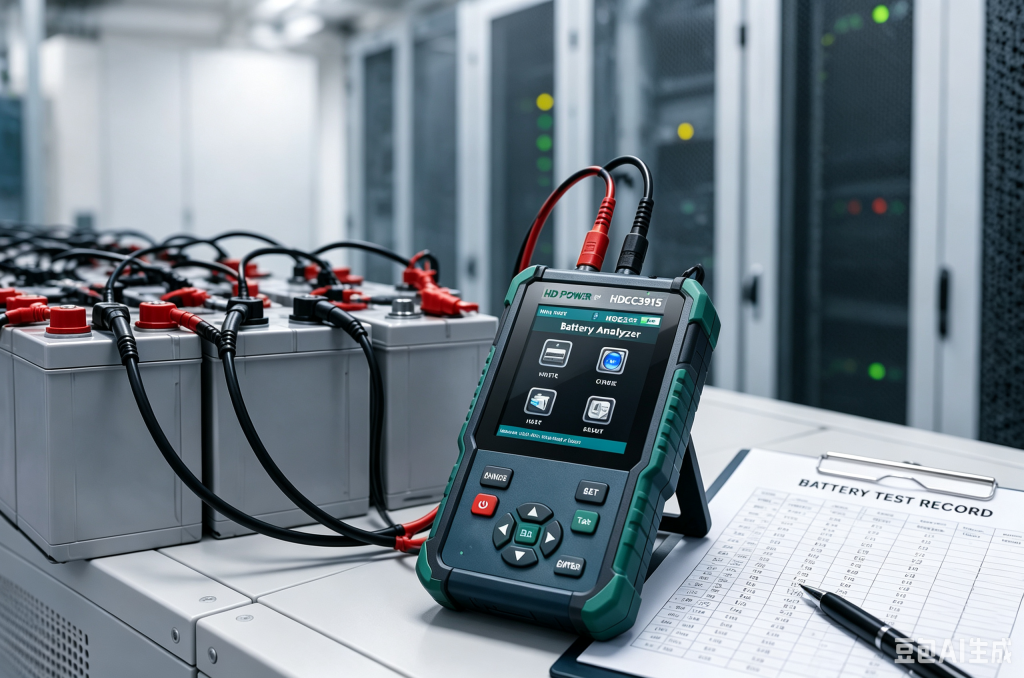
The HDGC3915 handheld battery testing instrument is designed to measure battery voltage and internal resistance using an AC discharge measurement method. According to its published specifications, it supports a resistance measurement range of 0.01 mΩ to 120 mΩ and a voltage measurement range of 1.000 V to 25 V.
The instrument supports individual battery and battery-group measurements, with online and offline testing modes. Its data storage and USB export functions help maintenance personnel organize readings for further analysis and reporting.
These capabilities can support routine inspection workflows where technicians need to compare individual batteries, investigate abnormal results, and maintain consistent records across inspection periods.
Before selecting the instrument, users should confirm that its measurement ranges and supported test procedures match their battery type, nominal voltage, installation conditions, and maintenance requirements.
For additional technical details, review the HDGC3915 Battery IR Tester product page or the HDPOWER Battery Analyzer product category.

Conclusion
UPS battery reliability depends on more than a normal voltage reading or the absence of alarms. Individual batteries can deteriorate at different rates, creating weaknesses that are difficult to identify through visual inspection alone.
A structured UPS Battery Bank Internal Resistance Testing program helps maintenance teams compare battery behavior, identify unusual measurements, and track changes over time. Its greatest value comes from consistent procedures, reliable historical records, and appropriate follow-up testing.
When combined with visual inspections, charging-system checks, and controlled capacity testing where necessary, internal resistance measurements provide useful evidence for preventive maintenance decisions.
For facilities that depend on uninterrupted backup power, a repeatable, data-driven battery maintenance process can improve fault investigation, support more informed replacement planning, and help teams manage battery assets with greater confidence.